
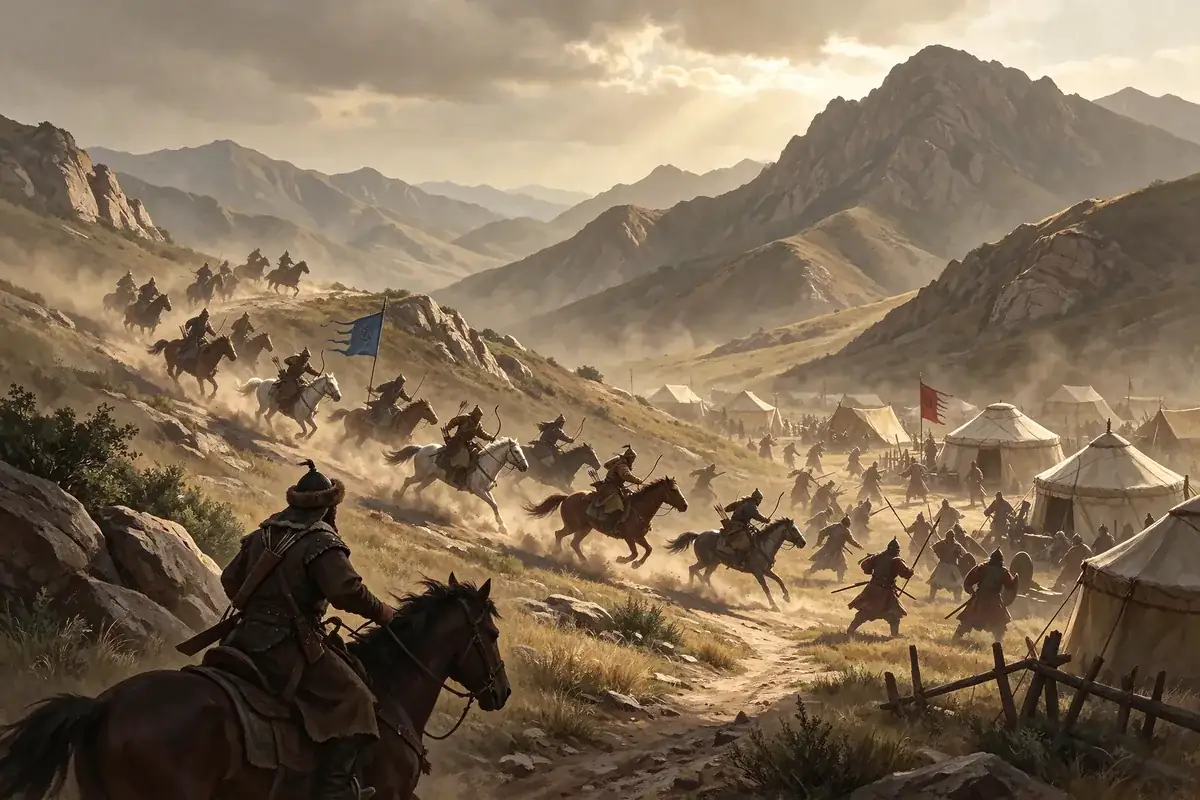
Genghis Khan personally led about 100,000 Mongol troops in their first major invasion of the Jin.1 The Jin deployed 450,000 men (claimed 500,000) to defend at Yehuling (present-day Wanquan District, Zhangjiakou, Hebei).2 The Mongol general Muqali proposed avoiding the main force and sent a cavalry detachment through a mountain path to surprise the Jin command.3 The Jin commander Wanyan Chengyu fled the battlefield, causing a complete rout; corpses covered the field.4 The Battle of Yehuling was a turning point in the Mongol-Jin war, as the Jin lost most of their elite forces and could never again mount large-scale field resistance against the Mongols.5
Evidence ledger
5 claims5 sourced0 unsourced
Every hard fact in the narrative above is registered here. A claim may also record source-only details that the narrative does not repeat; the related-narrative line points to the corresponding passage, not a guarantee that the source supports every word of the body. A claim without a source stays visibly unsourced.
- Battle of the Kalka River — WikipediaWikipedia, "Battle of the Kalka River", full article, evidence sentence 22
While awaiting Genghis' reply, Jebe and Subutai (another general pursuing Muhammad) led their army of 20,000 men, with each general commanding a tumen.
Accessed 2026-11-26 · machine excerpt · pending human review
L2: machine-extracted from the Wikipedia lead/full article and compared with the prose; not promoted to L3.
- Battle of the Kalka River — WikipediaWikipedia, "Battle of the Kalka River", full article, evidence sentence 22
The Jin deployed 450,000 men (claimed 500,000) to defend at Yehuling (present-day Wanquan District, Zhangjiakou, Hebei).
Related narrativeThe Jin deployed 450,000 men (claimed 500,000) to defend at Yehuling (present-day Wanquan District, Zhangjiakou, Hebei).
- Battle of the Kalka River — WikipediaWikipedia, "Battle of the Kalka River", full article, evidence sentence 22
While awaiting Genghis' reply, Jebe and Subutai (another general pursuing Muhammad) led their army of 20,000 men, with each general commanding a tumen.
Accessed 2026-11-26 · machine excerpt · pending human review
L2: machine-extracted from the Wikipedia lead/full article and compared with the prose; not promoted to L3.
- Battle of the Kalka River — WikipediaWikipedia, "Battle of the Kalka River", full article, evidence sentence 22
The Mongol general Muqali proposed avoiding the main force and sent a cavalry detachment through a mountain path to surprise the Jin command.
Related narrativeThe Mongol general Muqali proposed avoiding the main force and sent a cavalry detachment through a mountain path to surprise the Jin command.
- Battle of the Kalka River — WikipediaWikipedia, "Battle of the Kalka River", full article, evidence sentence 4
Following the Mongol invasion of Central Asia and the subsequent collapse of the Khwarezmian Empire, a Mongol force under the command of prominent Mongol Noyans (generals) Jebe and Subutai advanced into Iraq-i Ajam.
Accessed 2026-11-26 · machine excerpt · pending human review
L2: machine-extracted from the Wikipedia lead/full article and compared with the prose; not promoted to L3.
- Battle of the Kalka River — WikipediaWikipedia, "Battle of the Kalka River", full article, evidence sentence 4
The Jin commander Wanyan Chengyu fled the battlefield, causing a complete rout; corpses covered the field.
Related narrativeThe Jin commander Wanyan Chengyu fled the battlefield, causing a complete rout; corpses covered the field.
- Battle of the Kalka River — WikipediaWikipedia, "Battle of the Kalka River", full article, evidence sentence 74
The Mongols appear to have caught the coalition forces by surprise in a fast transition from horse archer fire to massed cavalry charges, because the coalition rout began incredibly quickly: the Rus forces bringing up the rear had not yet arrived on the battlefield by the time the front ranks were dissolving.
Accessed 2026-11-26 · machine excerpt · pending human review
L2: machine-extracted from the Wikipedia lead/full article and compared with the prose; not promoted to L3.
- Battle of the Kalka River — WikipediaWikipedia, "Battle of the Kalka River", full article, evidence sentence 74
The Battle of Yehuling was a turning point in the Mongol-Jin war, as the Jin lost most of their elite forces and could never again mount large-scale field resistance against the Mongols.
Related narrativeThe Battle of Yehuling was a turning point in the Mongol-Jin war, as the Jin lost most of their elite forces and could never again mount large-scale field resistance against the Mongols.
- Mongol Empire — WikipediaWikipedia, "Mongol Empire", full article, evidence sentence 172
This pivotal battle marked the western limit for Mongol expansion in the Middle East, and the Mongols were never again able to make serious military advances farther than Syria.
Accessed 2026-11-26 · machine excerpt · pending human review
L2: machine-extracted from the Wikipedia lead/full article and compared with the prose; not promoted to L3.
- Mongol Empire — WikipediaWikipedia, "Mongol Empire", full article, evidence sentence 172
Sources and review
English translation predates the current source revision
- Battle of the Kalka River — Wikipedia · Wikipedia contributors · Wikipedia lead and full article (accessed 2026-11-26) Original source ↗
- Mongol Empire — Wikipedia · Wikipedia contributors · Wikipedia lead and full article (accessed 2026-11-26) Original source ↗
L2 claims and source binding
L2 machine extraction plus manual comparison; no L3 two-source human confirmation.
Locations
- Mongol Empire· 40.9, 114.7· Approximate
evt-c648e1ef00e13674Source file:
events/evt-c648e1ef00e13674/event.md