
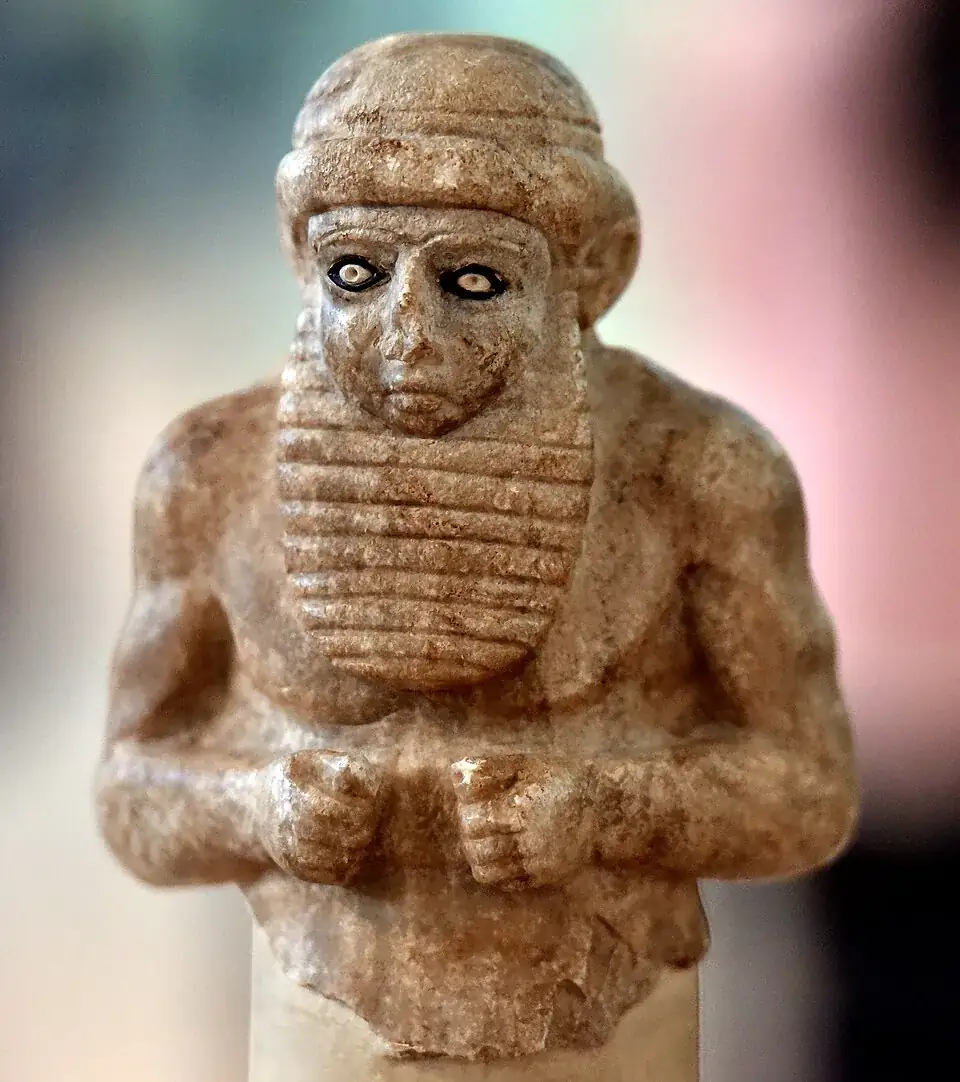
By about 3100 BCE, late Uruk culture was at its height.1 Uruk covered roughly 250 hectares and may have held 40,000 to 50,000 people, making it the largest city of its time.2 A wall about 9 kilometres long enclosed the Anu and Eanna temple districts and large storage areas. Monumental mud-brick buildings were decorated with painted clay cones, while large-scale sculpture, relief carving and lost-wax metal casting appeared in the same period. Through trade and colonization, Uruk culture carried cuneiform writing, cylinder seals and systems of measurement into Syria and western Iran. The city's scale, dense population and ceremonial core made it a model for later Mesopotamian urban life, and the walls remembered in the Epic of Gilgamesh belong to this phase.
Evidence ledger
3 claims2 sourced0 unsourced1 author judgment
Every hard fact in the narrative above is registered here. A claim may also record source-only details that the narrative does not repeat; the related-narrative line points to the corresponding passage, not a guarantee that the source supports every word of the body. A claim without a source stays visibly unsourced.
By about 3100 BCE, late Uruk culture was at its height.
Related narrativeBy about 3100 BCE, late Uruk culture was at its height.
- Mesopotamia, 8000-2000 B.C.Chronology, section 3500 B.C. → South
Uruk period, ca. 4000–3100 B.C.
Accessed 2026-11-09 · machine excerpt · pending human review
- Mesopotamia, 8000-2000 B.C.Chronology, section 3500 B.C. → South
Uruk covered roughly 250 hectares and may have held 40,000 to 50,000 people, making it the largest city of its time.
Related narrativeUruk covered roughly 250 hectares and may have held 40,000 to 50,000 people, making it the largest city of its time.
- Uruk: The First CityOpening paragraph
By around 3200 B.C., the largest settlement in southern Mesopotamia, if not the world, was Uruk: a true city dominated by monumental mud-brick buildings decorated with mosaics of painted clay cones embedded in the walls
Accessed 2026-11-09 · machine excerpt · pending human review
- Uruk: The First CityOpening paragraph
The overall context of the event body.
Related narrativeBy about 3100 BCE, late Uruk culture was at its height. Uruk covered roughly 250 hectares and may have held 40,000 to 50,000 people, making it the largest city of its time. A wall about 9 kilometres long enclosed the Anu and Eanna temple districts and large storage areas. Monumental mud-brick buildings were decorated with painted clay cones, while large-scale sculpture, relief carving and lost-wax metal casting appeared in the same period. Through trade and colonization, Uruk culture carried cuneiform writing, cylinder seals and systems of measurement into Syria and western Iran. The city's scale, dense population and ceremonial core made it a model for later Mesopotamian urban life, and the walls remembered in the Epic of Gilgamesh belong to this phase.
Editorial judgment, not a historical fact.
Author judgment covering the body context; not a factual source.
Sources and review
- Mesopotamia, 8000-2000 B.C. · The Metropolitan Museum of Art (accessed 2026-11-04) Original source ↗
- Uruk: The First City · The Metropolitan Museum of Art, Department of Ancient Near Eastern Art (accessed 2026-11-04) Original source ↗
Locations
- Mesopotamia· 31.32, 45.64· Approximate
evt-e81db48ec58782fbSource file:
events/evt-e81db48ec58782fb/event.md