
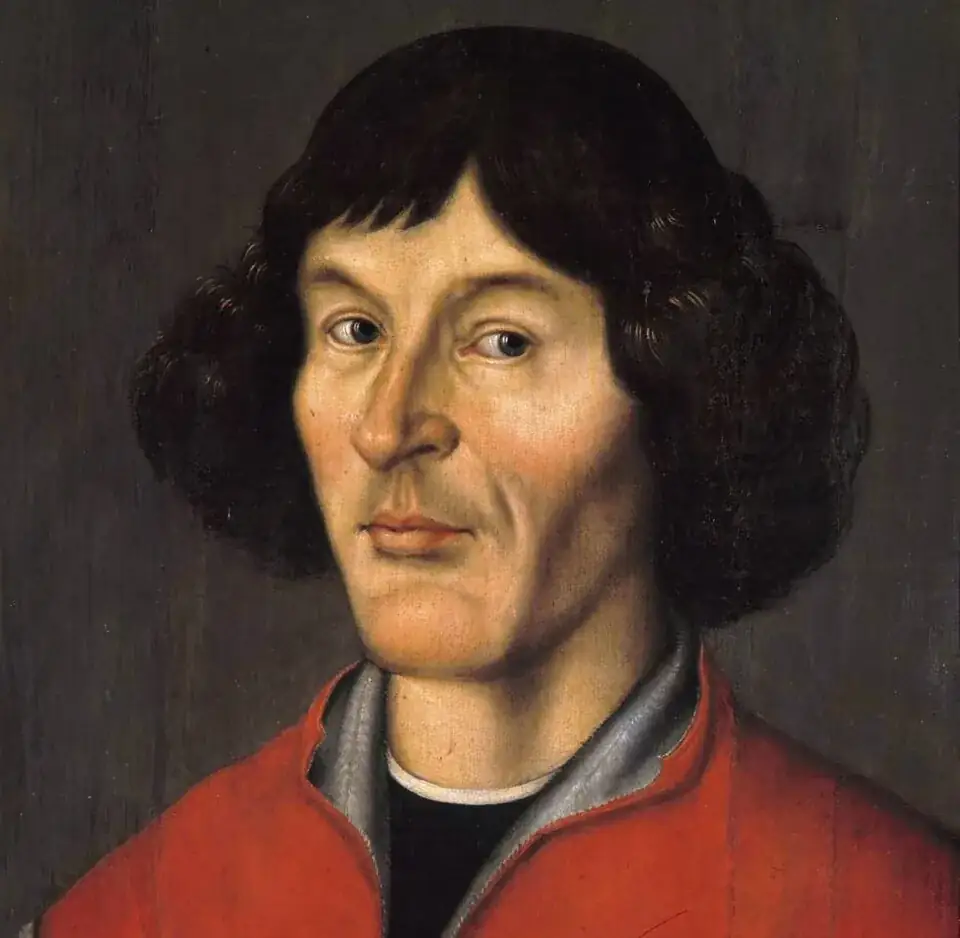
Copernicus died at Frombork in 1543, the same year his life's work De revolutionibus orbium coelestium was printed in Nuremberg.1 The book placed the Sun near the centre of the planetary system and set the Earth in motion around it.2 That claim challenged the geocentric cosmology that had shaped learned Europe for centuries and helped open the Scientific Revolution. Copernicus did not live to see the controversy his argument provoked. The juxtaposition of his death and the book's appearance makes 1543 a hinge between an older cosmos and a new one. The printed volume carried the argument beyond a single lifetime, turning a personal conclusion into a public intellectual problem. Readers could compare the book with older cosmologies and argue over its claims in print. The Library of Congress name record gives his life dates as 1473–1543.
Evidence ledger
3 claims2 sourced0 unsourced1 author judgment
Every hard fact in the narrative above is registered here. A claim may also record source-only details that the narrative does not repeat; the related-narrative line points to the corresponding passage, not a guarantee that the source supports every word of the body. A claim without a source stays visibly unsourced.
- Title page of De revolutionibus orbium coelestium (1543)Names
Copernicus, Nicolaus, 1473-1543.
Accessed 2026-11-09 · machine excerpt · pending human review - Nicolaus CopernicusSection 1. Life and Works, opening paragraph
Nicolaus Copernicus (1473–1543) was a mathematician and astronomer
Accessed 2026-11-20 · machine excerpt · pending human review
- Title page of De revolutionibus orbium coelestium (1543)Names
The book placed the Sun near the centre of the planetary system and set the Earth in motion around it.
Related narrativeThe book placed the Sun near the centre of the planetary system and set the Earth in motion around it.
- Title page of De revolutionibus orbium coelestium (1543)Names
Copernicus, Nicolaus, 1473-1543.
Accessed 2026-11-09 · machine excerpt · pending human review
- Title page of De revolutionibus orbium coelestium (1543)Names
The overall context of the event body.
Related narrativeCopernicus died at Frombork in 1543, the same year his life's work De revolutionibus orbium coelestium was printed in Nuremberg. The book placed the Sun near the centre of the planetary system and set the Earth in motion around it. That claim challenged the geocentric cosmology that had shaped learned Europe for centuries and helped open the Scientific Revolution. Copernicus did not live to see the controversy his argument provoked. The juxtaposition of his death and the book's appearance makes 1543 a hinge between an older cosmos and a new one. The printed volume carried the argument beyond a single lifetime, turning a personal conclusion into a public intellectual problem. Readers could compare the book with older cosmologies and argue over its claims in print. The Library of Congress name record gives his life dates as 1473–1543.
Editorial judgment, not a historical fact.
Author judgment covering the body context; not a factual source.
Sources and review
Cross-check · 2026-11-20 · The Stanford entry and the Library of Congress name record both support Copernicus’s death in 1543; the body keeps only the life-date fact.
- Title page of De revolutionibus orbium coelestium (1543) · Library of Congress (accessed 2026-11-04) Original source ↗
- Nicolaus Copernicus · Sheila Rabin · Stanford Encyclopedia of Philosophy (accessed 2026-11-20) Original source ↗
Locations
- Poland· 54.36, 19.69· Approximate
evt-b897b3498c659022Source file:
events/evt-b897b3498c659022/event.md