
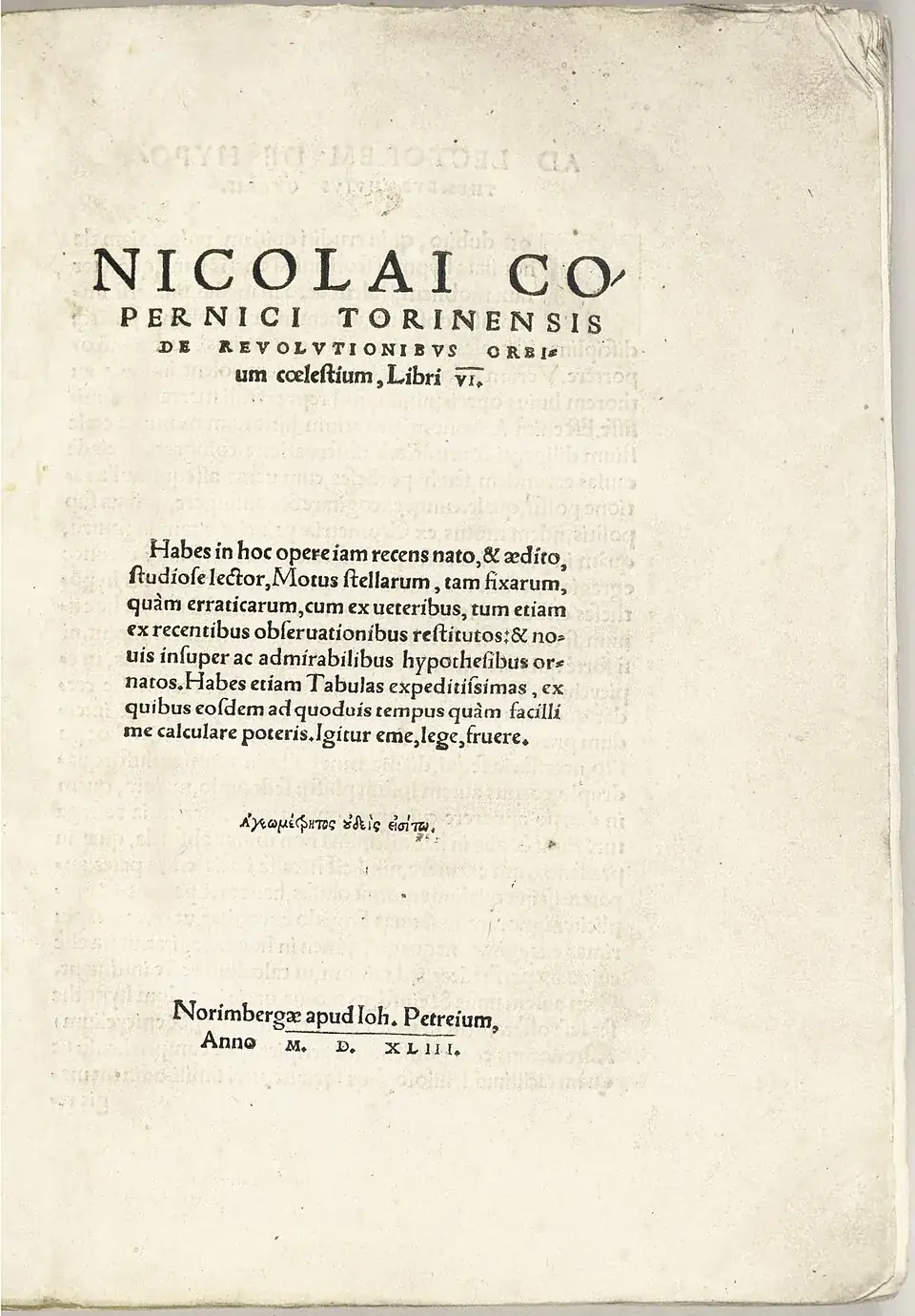
In 1543 De revolutionibus orbium coelestium was published and argued that the Sun, not the Earth, stood at the centre of the cosmos.1 The Earth was said to turn on its axis and to travel around the Sun, while the planets moved around it. The claim reversed the familiar hierarchy of a stationary Earth and a moving sky. It did not convince everyone at once, but it gave later astronomers a model to test, refine and dispute. The book appeared in print, which allowed its argument to circulate beyond a single observatory or court. Its publication is often treated as the opening of the Scientific Revolution, less because it settled the question than because it changed what could be asked. The book remained a point of reference for later work.
Evidence ledger
2 claims1 sourced0 unsourced1 author judgment
Every hard fact in the narrative above is registered here. A claim may also record source-only details that the narrative does not repeat; the related-narrative line points to the corresponding passage, not a guarantee that the source supports every word of the body. A claim without a source stays visibly unsourced.
- Title page of De revolutionibus orbium coelestium (1543)Created / Published
published 1543
Accessed 2026-11-09 · machine excerpt · pending human review - Title page of De revolutionibus orbium coelestium (1543)Title
with statement that the sun, and not the earth, is the center of our universe
Accessed 2026-11-09 · machine excerpt · pending human review - Nicolaus CopernicusOpening abstract
Nicolaus Copernicus (1473–1543) was a mathematician and astronomer who proposed that the sun was stationary in the center of the universe and the earth revolved around it.
Accessed 2026-11-20 · machine excerpt · pending human review
- Title page of De revolutionibus orbium coelestium (1543)Created / Published
The overall context of the event body.
Related narrativeIn 1543 De revolutionibus orbium coelestium was published and argued that the Sun, not the Earth, stood at the centre of the cosmos. The Earth was said to turn on its axis and to travel around the Sun, while the planets moved around it. The claim reversed the familiar hierarchy of a stationary Earth and a moving sky. It did not convince everyone at once, but it gave later astronomers a model to test, refine and dispute. The book appeared in print, which allowed its argument to circulate beyond a single observatory or court. Its publication is often treated as the opening of the Scientific Revolution, less because it settled the question than because it changed what could be asked. The book remained a point of reference for later work.
Editorial judgment, not a historical fact.
Author judgment covering the body context; not a factual source.
Sources and review
Cross-check · 2026-11-20 · The Stanford entry and the Library of Congress record both support the 1543 heliocentric proposal in De revolutionibus; the body does not present later acceptance as contemporary consensus.
- Title page of De revolutionibus orbium coelestium (1543) · Library of Congress (accessed 2026-11-04) Original source ↗
- Nicolaus Copernicus · Sheila Rabin · Stanford Encyclopedia of Philosophy (accessed 2026-11-20) Original source ↗
Locations
- Poland· 52, 18· Approximate
evt-5cdca1f98879377fSource file:
events/evt-5cdca1f98879377f/event.md