
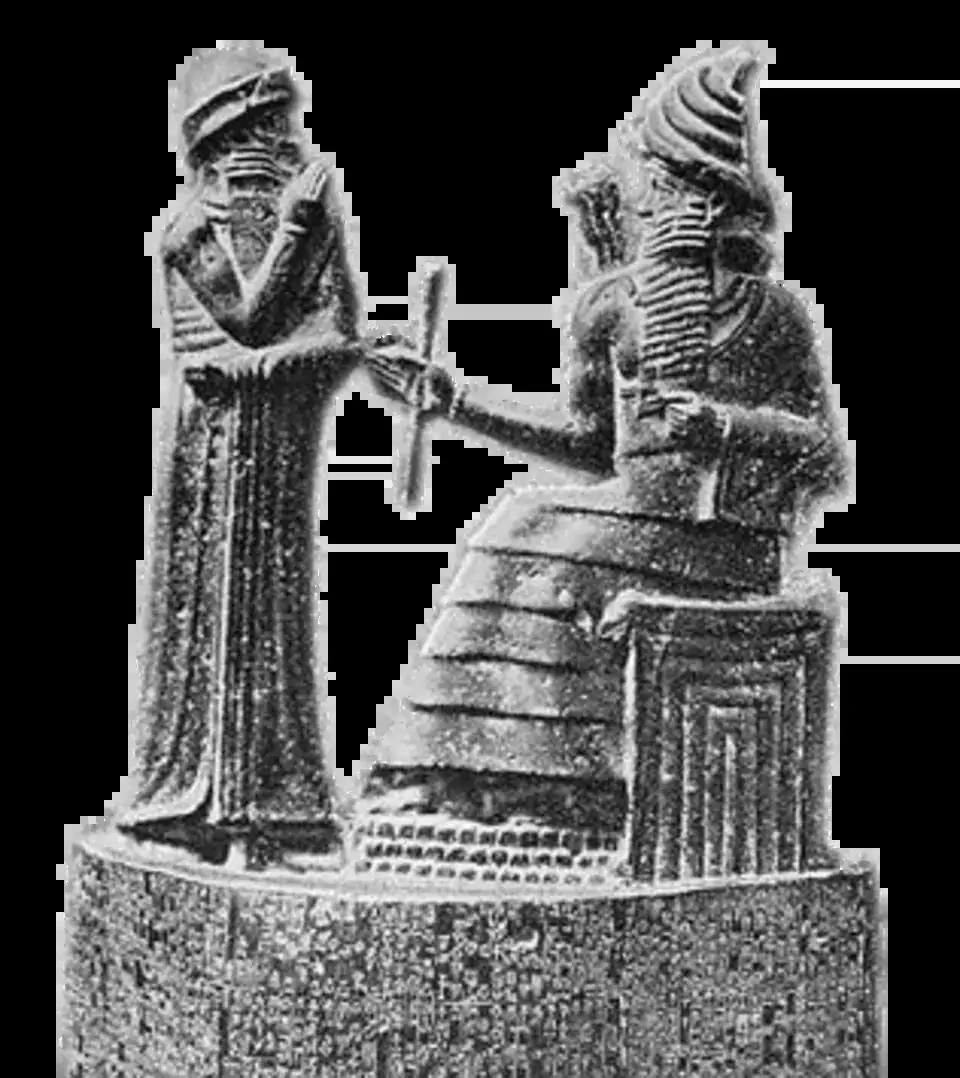
The Hammurabi stele in the Louvre is carved from black basalt and stands about 2.25 metres high.1 Its inscription was cut around 1750 BCE and gathers nearly 280 judicial decisions.2 The text is conventionally called a code, but it is better understood as a collection of ancient legal decisions than as a modern comprehensive statute book. French excavations at Susa, in Iran, found the stele in 1902. It had been carried there centuries after it was made, as war booty, by the Elamite king Shutruk-Nahhunte. The Louvre has displayed it since 1904. The stele matters both as a legal record and as an object whose journey shows how monuments are moved, reused and given new meanings over time, and how law itself can be tied to a physical object.
Evidence ledger
3 claims2 sourced0 unsourced1 author judgment
Every hard fact in the narrative above is registered here. A claim may also record source-only details that the narrative does not repeat; the related-narrative line points to the corresponding passage, not a guarantee that the source supports every word of the body. A claim without a source stays visibly unsourced.
The Hammurabi stele in the Louvre is carved from black basalt and stands about 2.25 metres high.
Related narrativeThe Hammurabi stele in the Louvre is carved from black basalt and stands about 2.25 metres high.
- Le Code de HammurabiSection: Un monument du droit ancien
Taillée dans un bloc de basalte noir de plus de 2,25 mètres de haut
Accessed 2026-11-09 · machine excerpt · pending human review - Code de Hammurabi — Louvre collectionsPhysical characteristics: Dimensions; Materials
Hauteur : 225 cm ; Largeur : 79 cm ; Epaisseur : 47 cm. Matériau : basalte
Accessed 2026-11-09 · machine excerpt · pending human review
- Le Code de HammurabiSection: Un monument du droit ancien
Its inscription was cut around 1750 BCE and gathers nearly 280 judicial decisions.
Related narrativeIts inscription was cut around 1750 BCE and gathers nearly 280 judicial decisions.
- Le Code de HammurabiSection: Un monument du droit ancien
Gravé vers 1750 avant Jésus-Christ
Accessed 2026-11-09 · machine excerpt · pending human review - Code de Hammurabi — Louvre collectionsPlaces and dates: Date
1ère dynastie de Babylone : Hammurabi (-1792 - -1750)
Accessed 2026-11-09 · machine excerpt · pending human review
- Le Code de HammurabiSection: Un monument du droit ancien
The overall context of the event body.
Related narrativeThe Hammurabi stele in the Louvre is carved from black basalt and stands about 2.25 metres high. Its inscription was cut around 1750 BCE and gathers nearly 280 judicial decisions. The text is conventionally called a code, but it is better understood as a collection of ancient legal decisions than as a modern comprehensive statute book. French excavations at Susa, in Iran, found the stele in 1902. It had been carried there centuries after it was made, as war booty, by the Elamite king Shutruk-Nahhunte. The Louvre has displayed it since 1904. The stele matters both as a legal record and as an object whose journey shows how monuments are moved, reused and given new meanings over time, and how law itself can be tied to a physical object.
Editorial judgment, not a historical fact.
Author judgment covering the body context; not a factual source.
Sources and review
- Le Code de Hammurabi · Musee du Louvre (accessed 2026-11-04) Original source ↗
- Code de Hammurabi — Louvre collections · Musée du Louvre, Département des Antiquités orientales (accessed 2026-11-09) Original source ↗
Title, dating qualifiers and rewritten body compared with the cited institutional records.
AI-assisted source comparison, not external expert certification. Legacy map coordinates, other events and whole-topic verification are outside this review scope.
Locations
- Babylonia· 32.5, 44.4· Approximate
evt-f547f3cbc1614a00Source file:
events/evt-f547f3cbc1614a00/event.md