
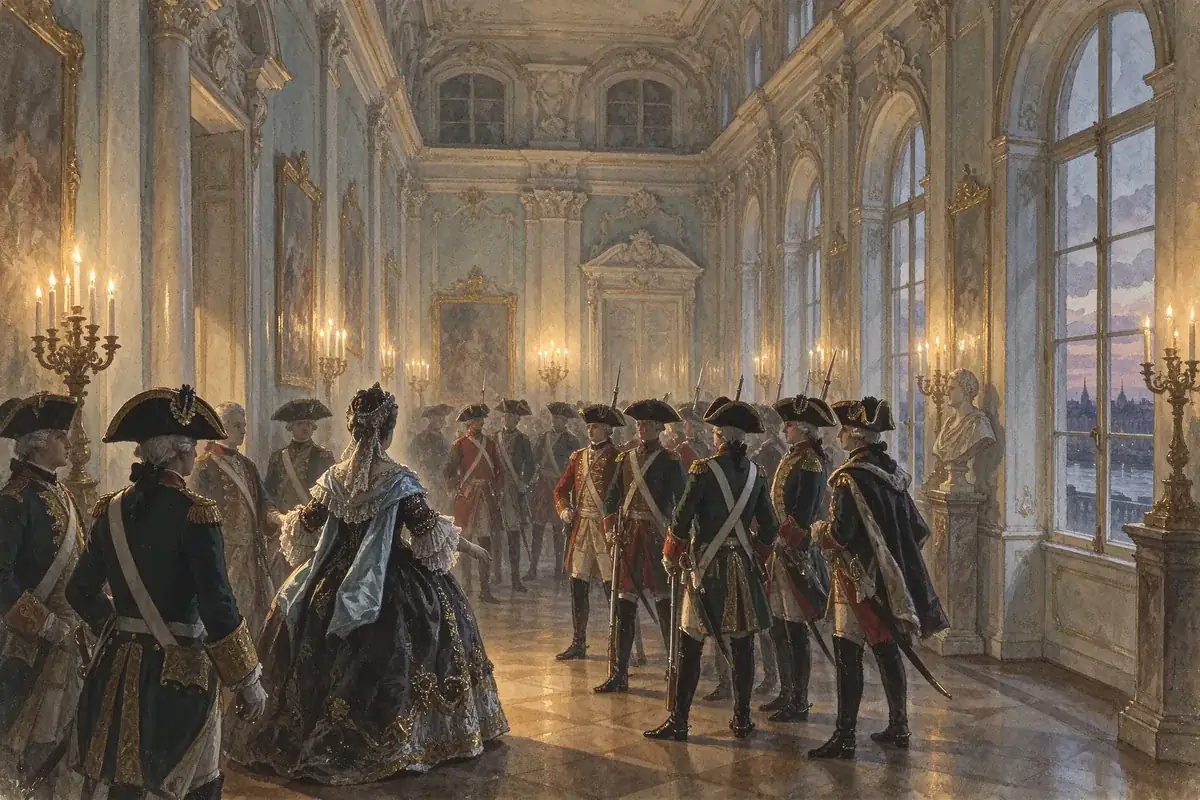
Empress Elizabeth of Russia dies, and her nephew Peter III ascends.1 Peter III, an admirer of Frederick the Great of Prussia, immediately orders Russia to withdraw from the Seven Years' War and return occupied East Prussia.2 This betrayal enrages the Russian nobility and army.3 Catherine (Peter III's wife) leads a coup with the support of the Guard, deposes and murders Peter III, and ascends as Catherine II (Catherine the Great).4 She pursues enlightened absolutism, corresponds with Voltaire and Diderot, launches Russo-Turkish wars to secure access to the Black Sea, and participates in three partitions of Poland, making Russia a first-rate European power.5
Evidence ledger
5 claims1 sourced4 unsourced
Every hard fact in the narrative above is registered here. A claim may also record source-only details that the narrative does not repeat; the related-narrative line points to the corresponding passage, not a guarantee that the source supports every word of the body. A claim without a source stays visibly unsourced.
Empress Elizabeth of Russia dies, and her nephew Peter III ascends.
Related narrativeEmpress Elizabeth of Russia dies, and her nephew Peter III ascends.
No source registered. This assertion remains unverified.
Bulk context rewrite; sources pending
Peter III, an admirer of Frederick the Great of Prussia, immediately orders Russia to withdraw from the Seven Years' War and return occupied East Prussia.
Related narrativePeter III, an admirer of Frederick the Great of Prussia, immediately orders Russia to withdraw from the Seven Years' War and return occupied East Prussia.
No source registered. This assertion remains unverified.
Bulk context rewrite; sources pending
This betrayal enrages the Russian nobility and army.
Related narrativeThis betrayal enrages the Russian nobility and army.
No source registered. This assertion remains unverified.
Bulk context rewrite; sources pending
Catherine (Peter III's wife) leads a coup with the support of the Guard, deposes and murders Peter III, and ascends as Catherine II (Catherine the Great).
Related narrativeCatherine (Peter III's wife) leads a coup with the support of the Guard, deposes and murders Peter III, and ascends as Catherine II (Catherine the Great).
- Catherine the GreatOpening paragraph
Catherine the Great ... was a German-born empress of Russia (1762–96) ...
Accessed 2026-11-21 · machine excerpt · pending human review
Bulk context rewrite; sources pending
- Catherine the GreatOpening paragraph
She pursues enlightened absolutism, corresponds with Voltaire and Diderot, launches Russo-Turkish wars to secure access to the Black Sea, and participates in three partitions of Poland, making Russia a first-rate European power.
Related narrativeShe pursues enlightened absolutism, corresponds with Voltaire and Diderot, launches Russo-Turkish wars to secure access to the Black Sea, and participates in three partitions of Poland, making Russia a first-rate European power.
No source registered. This assertion remains unverified.
Bulk context rewrite; sources pending
Sources and review
English translation predates the current source revision; 4 key claims have no binding source; Unsourced key claims keep the event at structure level
- Catherine the Great · Encyclopaedia Britannica (accessed 2026-11-21) Original source ↗
Locations
- Russia· 55.8, 37.6· Approximate
evt-ef93c83d4e2e9545Source file:
events/evt-ef93c83d4e2e9545/event.md