
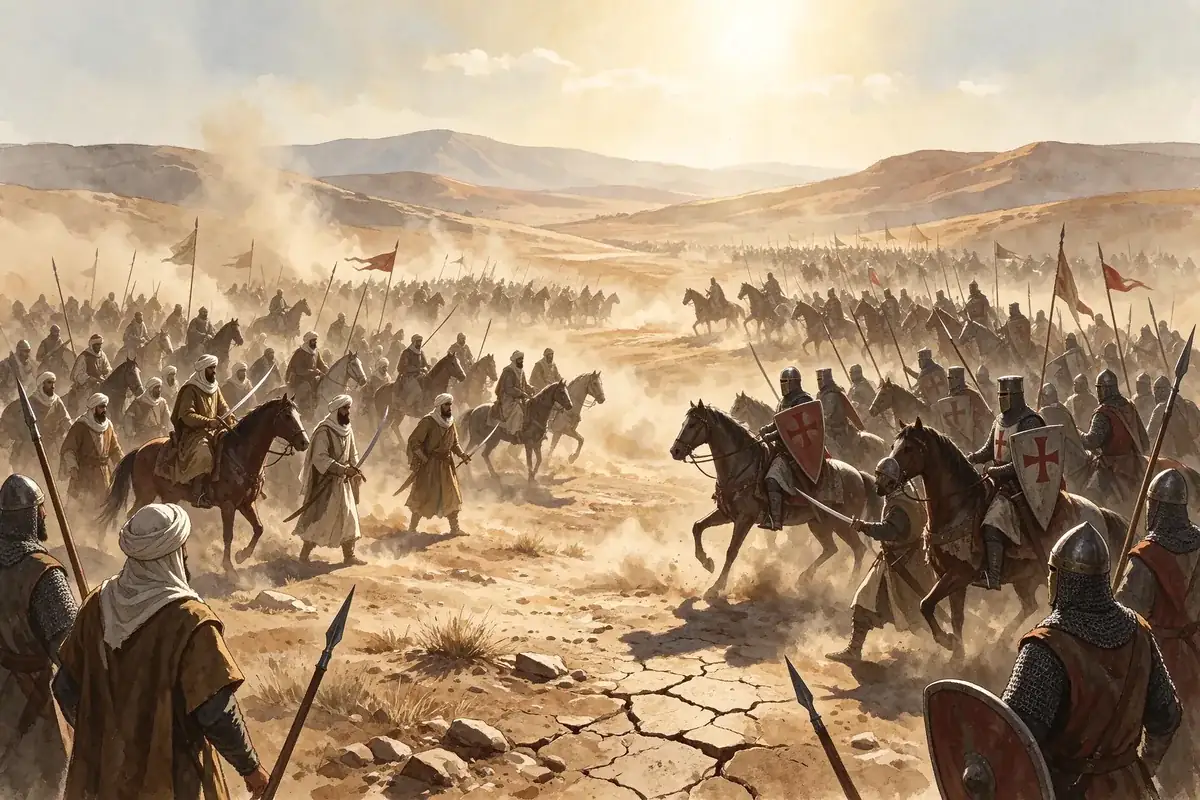
On July 4, the Ayyubid sultan Saladin, with about 30,000 troops, decisively defeated the army of the Kingdom of Jerusalem (about 20,000) at Hattin (near modern Tiberias, Israel).1 King Guy of Lusignan of Jerusalem, Raynald of Châtillon, the master of the Knights Templar, and others were captured.2 Saladin executed Raynald (for repeatedly violating truces) but treated the king mercifully.3 On October 2, Saladin entered Jerusalem.4 Unlike the crusaders in 1099, he did not slaughter the inhabitants but allowed Christians to leave peacefully after paying a ransom.5 The Kingdom of Jerusalem effectively ended, with only a few coastal cities like Tripoli and Antioch remaining.6 This event triggered the Third Crusade (1189–1192).7
Evidence ledger
7 claims1 sourced6 unsourced
Every hard fact in the narrative above is registered here. A claim may also record source-only details that the narrative does not repeat; the related-narrative line points to the corresponding passage, not a guarantee that the source supports every word of the body. A claim without a source stays visibly unsourced.
- Battle of ḤaṭṭīnOpening paragraph
Battle of Ḥaṭṭīn, (July 4, 1187), battle in northern Palestine that marked the defeat and annihilation of the Christian Crusader armies of Guy de Lusignan, king of Jerusalem (reigned 1186–92), by the Muslim forces of Saladin. It paved the way for the Muslim reconquest of the city of Jerusalem (October 1187).
Accessed 2026-11-21 · machine excerpt · pending human review
Bulk context rewrite; sources pending
- Battle of ḤaṭṭīnOpening paragraph
King Guy of Lusignan of Jerusalem, Raynald of Châtillon, the master of the Knights Templar, and others were captured.
Related narrativeKing Guy of Lusignan of Jerusalem, Raynald of Châtillon, the master of the Knights Templar, and others were captured.
No source registered. This assertion remains unverified.
Bulk context rewrite; sources pending
Saladin executed Raynald (for repeatedly violating truces) but treated the king mercifully.
Related narrativeSaladin executed Raynald (for repeatedly violating truces) but treated the king mercifully.
No source registered. This assertion remains unverified.
Bulk context rewrite; sources pending
On October 2, Saladin entered Jerusalem.
Related narrativeOn October 2, Saladin entered Jerusalem.
No source registered. This assertion remains unverified.
Bulk context rewrite; sources pending
Unlike the crusaders in 1099, he did not slaughter the inhabitants but allowed Christians to leave peacefully after paying a ransom.
Related narrativeUnlike the crusaders in 1099, he did not slaughter the inhabitants but allowed Christians to leave peacefully after paying a ransom.
No source registered. This assertion remains unverified.
Bulk context rewrite; sources pending
The Kingdom of Jerusalem effectively ended, with only a few coastal cities like Tripoli and Antioch remaining.
Related narrativeThe Kingdom of Jerusalem effectively ended, with only a few coastal cities like Tripoli and Antioch remaining.
No source registered. This assertion remains unverified.
Bulk context rewrite; sources pending
This event triggered the Third Crusade (1189–1192).
Related narrativeThis event triggered the Third Crusade (1189–1192).
No source registered. This assertion remains unverified.
Bulk context rewrite; sources pending
Sources and review
English translation predates the current source revision; 6 key claims have no binding source; Unsourced key claims keep the event at structure level
- Battle of Ḥaṭṭīn · Encyclopaedia Britannica (accessed 2026-11-21) Original source ↗
Locations
- Middle East· 32.8, 35.5· Approximate
evt-ec05a1c1bfb4bccaSource file:
events/evt-ec05a1c1bfb4bcca/event.md