
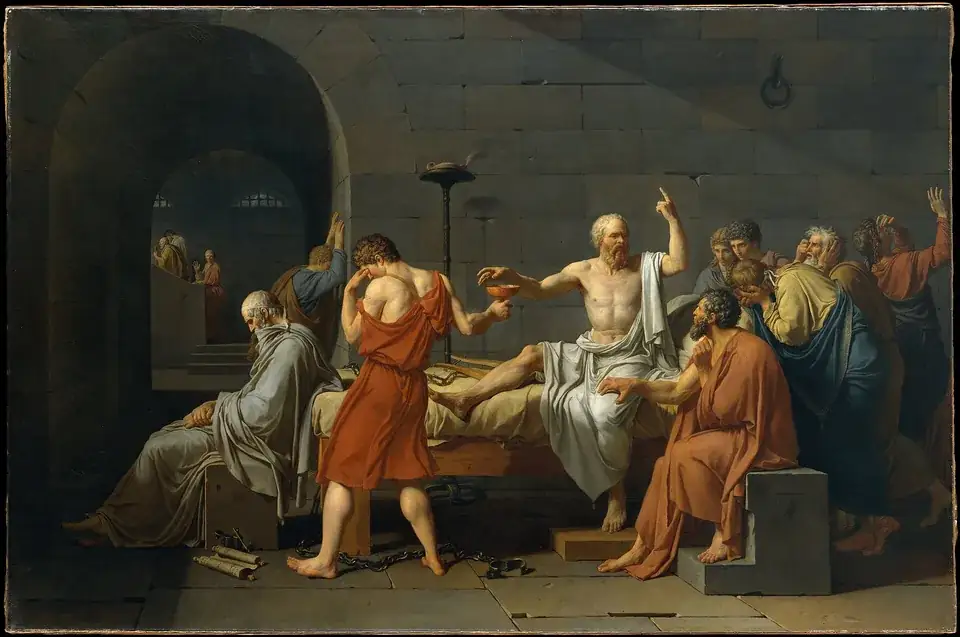
In 399 BCE, Socrates was sentenced to death by the Athenian court for "corrupting youth" and "disrespecting the gods of the city".1 He was about seventy years old and died from drinking poisonous pansy juice.2 His words and deeds were recorded and handed down to the world by his disciples Plato and Xenophon, confirming his philosophical life with his death.3 The trial was held after the crisis in the city-state, and the defendant's cross-examination angered the public; the dialogue in prison and the calmness before execution became the starting point for later discussions on the relationship between philosophers and the city-state.4
Evidence ledger
4 claims0 sourced4 unsourced
Every hard fact in the narrative above is registered here. A claim may also record source-only details that the narrative does not repeat; the related-narrative line points to the corresponding passage, not a guarantee that the source supports every word of the body. A claim without a source stays visibly unsourced.
No source registered. This assertion remains unverified.
Rebuilt after English expansion; unverified.
He was about seventy years old and died from drinking poisonous pansy juice.
Related narrativeHe was about seventy years old and died from drinking poisonous pansy juice.
No source registered. This assertion remains unverified.
Rebuilt after English expansion; unverified.
His words and deeds were recorded and handed down to the world by his disciples Plato and Xenophon, confirming his philosophical life with his death.
Related narrativeHis words and deeds were recorded and handed down to the world by his disciples Plato and Xenophon, confirming his philosophical life with his death.
No source registered. This assertion remains unverified.
Rebuilt after English expansion; unverified.
The trial was held after the crisis in the city-state, and the defendant's cross-examination angered the public; the dialogue in prison and the calmness before execution became the starting point for later discussions on the relationship between philosophers and the city-state.
Related narrativeThe trial was held after the crisis in the city-state, and the defendant's cross-examination angered the public; the dialogue in prison and the calmness before execution became the starting point for later discussions on the relationship between philosophers and the city-state.
No source registered. This assertion remains unverified.
Rebuilt after English expansion; unverified.
Sources and review
4 key claims have no binding source; Unsourced key claims keep the event at structure level
Locations
- Greece· 37.97, 23.73· Approximate
evt-ebab05ec15e4eae1Source file:
events/evt-ebab05ec15e4eae1/event.md