
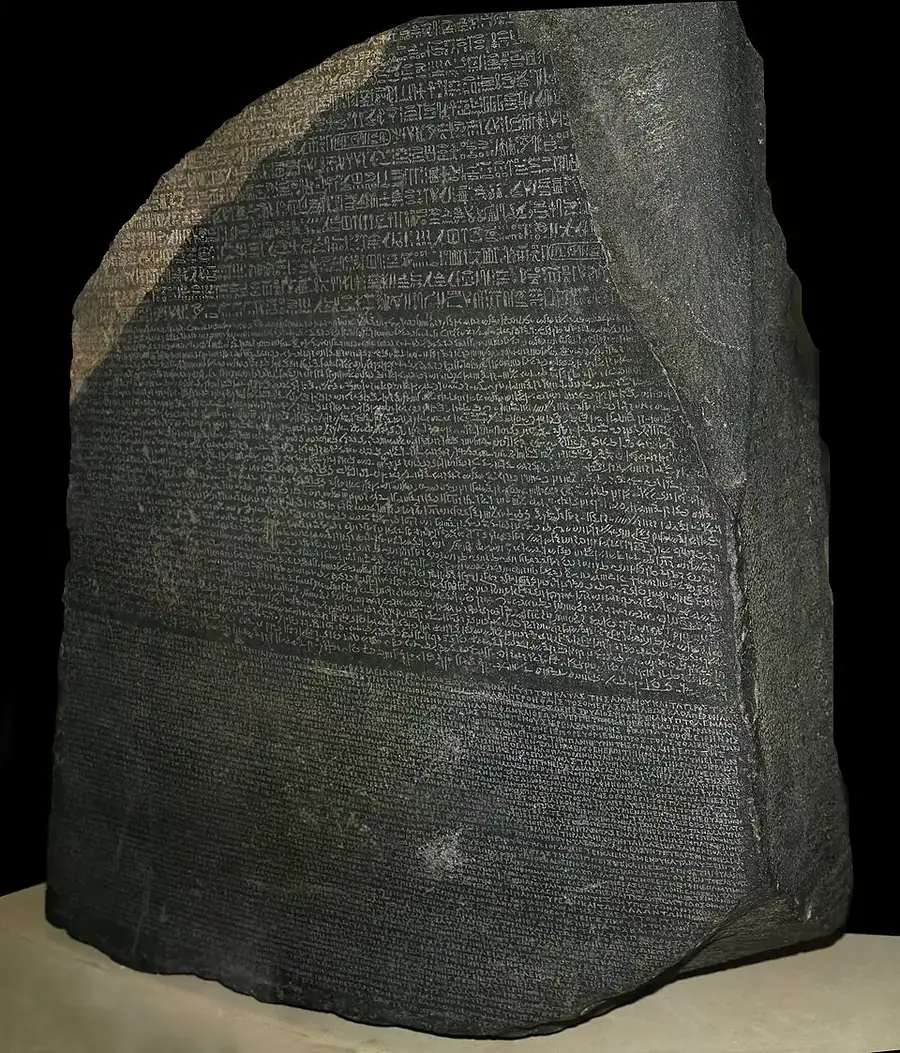
Egyptian priests of Ptolemy V (reigned 204–181 BCE) had the Rosetta Stone carved to honor the king's coronation.1 It bears the same text in three scripts: Egyptian hieroglyphs, Demotic, and Greek.2 Discovered in 1799, it was the key for Champollion to decipher ancient Egyptian writing.3 At this time Ptolemaic Egypt was declining and relied on priestly support.4
Evidence ledger
4 claims0 sourced4 unsourced
Every hard fact in the narrative above is registered here. A claim may also record source-only details that the narrative does not repeat; the related-narrative line points to the corresponding passage, not a guarantee that the source supports every word of the body. A claim without a source stays visibly unsourced.
No source registered. This assertion remains unverified.
Bulk context rewrite; sources pending
It bears the same text in three scripts: Egyptian hieroglyphs, Demotic, and Greek.
Related narrativeIt bears the same text in three scripts: Egyptian hieroglyphs, Demotic, and Greek.
No source registered. This assertion remains unverified.
Bulk context rewrite; sources pending
Discovered in 1799, it was the key for Champollion to decipher ancient Egyptian writing.
Related narrativeDiscovered in 1799, it was the key for Champollion to decipher ancient Egyptian writing.
No source registered. This assertion remains unverified.
Bulk context rewrite; sources pending
At this time Ptolemaic Egypt was declining and relied on priestly support.
Related narrativeAt this time Ptolemaic Egypt was declining and relied on priestly support.
No source registered. This assertion remains unverified.
Bulk context rewrite; sources pending
Sources and review
English translation predates the current source revision; 4 key claims have no binding source; Unsourced key claims keep the event at structure level
Locations
- Ptolemaic Egypt· 31.2, 29.9· Approximate
evt-dbfca27208e849ffSource file:
events/evt-dbfca27208e849ff/event.md