
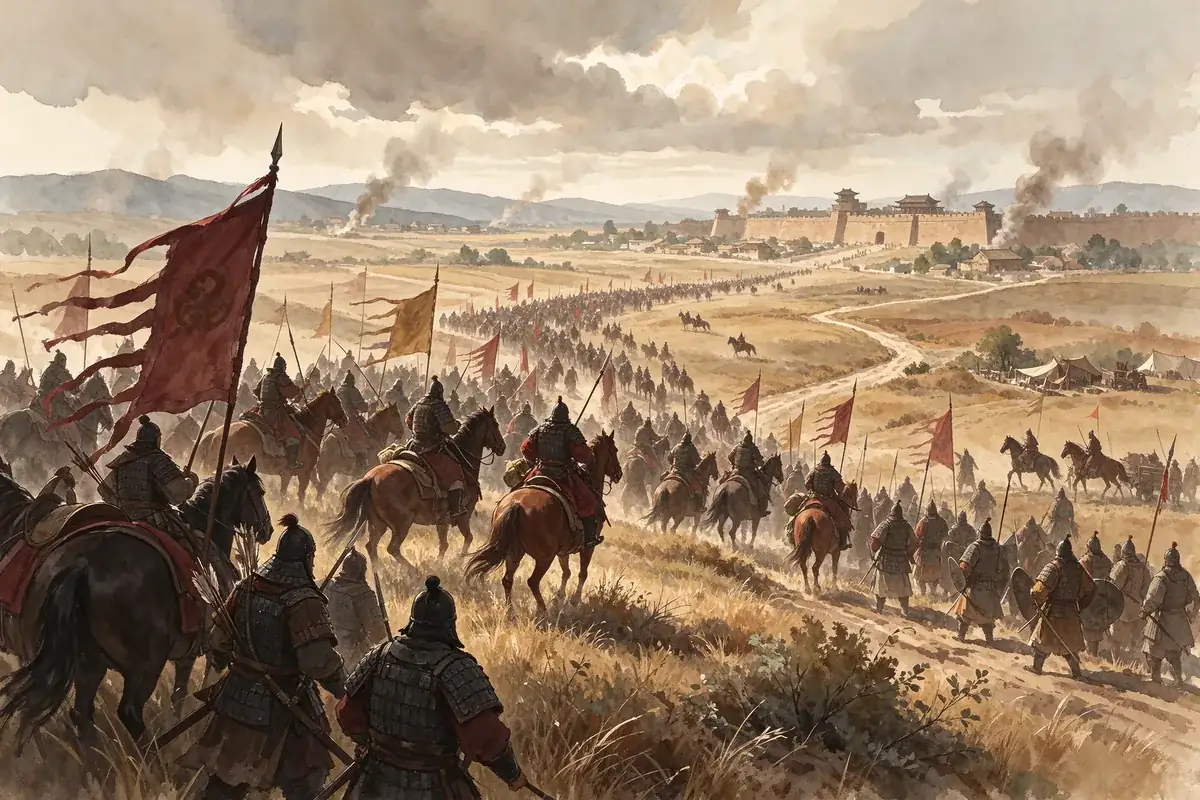
On the ninth day of the eleventh month of 755, An Lushan, who concurrently held the three jiedushi positions of Fanyang, Pinglu, and Hedong, raised a rebellion in Fanyang (modern Beijing) under the pretext of receiving a secret edict to punish Yang Guozhong.1 An Lushan led 150,000 rebel troops southward, meeting little resistance.2 Emperor Xuanzong hurriedly ordered Feng Changqing and Gao Xianzhi to defend, but Luoyang soon fell.3 In the twelfth month, An Lushan proclaimed himself emperor of the Great Yan dynasty in Luoyang.4 The An-Shi Rebellion was the turning point of Tang's decline from prosperity to decay and lasted eight years.5
Evidence ledger
5 claims1 sourced4 unsourced
Every hard fact in the narrative above is registered here. A claim may also record source-only details that the narrative does not repeat; the related-narrative line points to the corresponding passage, not a guarantee that the source supports every word of the body. A claim without a source stays visibly unsourced.
- An LushanSection 'An Lushan’s rebellion', paragraphs 1–5
Finally, toward the end of 755, alleging that he had received a secret command from the emperor to get rid of Yang Guozhong, An Lushan turned his large, war-hardened army inward and marched on Luoyang. Within a month the rebels had taken Luoyang, and at the beginning of the lunar year corresponding to 756 An Lushan proclaimed himself emperor of the Great Yen dynasty. Finally in 763 it officially came to an end with the defeat and death of Shi Chaoyi.
Accessed 2026-11-21 · machine excerpt · pending human review
Bulk context rewrite; sources pending
- An LushanSection 'An Lushan’s rebellion', paragraphs 1–5
An Lushan led 150,000 rebel troops southward, meeting little resistance.
Related narrativeAn Lushan led 150,000 rebel troops southward, meeting little resistance.
No source registered. This assertion remains unverified.
Bulk context rewrite; sources pending
Emperor Xuanzong hurriedly ordered Feng Changqing and Gao Xianzhi to defend, but Luoyang soon fell.
Related narrativeEmperor Xuanzong hurriedly ordered Feng Changqing and Gao Xianzhi to defend, but Luoyang soon fell.
No source registered. This assertion remains unverified.
Bulk context rewrite; sources pending
In the twelfth month, An Lushan proclaimed himself emperor of the Great Yan dynasty in Luoyang.
Related narrativeIn the twelfth month, An Lushan proclaimed himself emperor of the Great Yan dynasty in Luoyang.
No source registered. This assertion remains unverified.
Bulk context rewrite; sources pending
The An-Shi Rebellion was the turning point of Tang's decline from prosperity to decay and lasted eight years.
Related narrativeThe An-Shi Rebellion was the turning point of Tang's decline from prosperity to decay and lasted eight years.
No source registered. This assertion remains unverified.
Bulk context rewrite; sources pending
Sources and review
English translation predates the current source revision; 4 key claims have no binding source; Unsourced key claims keep the event at structure level
- An Lushan · Encyclopaedia Britannica (accessed 2026-11-21) Original source ↗
Locations
- Tang Dynasty· 38.62, 112.58· Approximate
evt-bd7df4df95fb443eSource file:
events/evt-bd7df4df95fb443e/event.md