
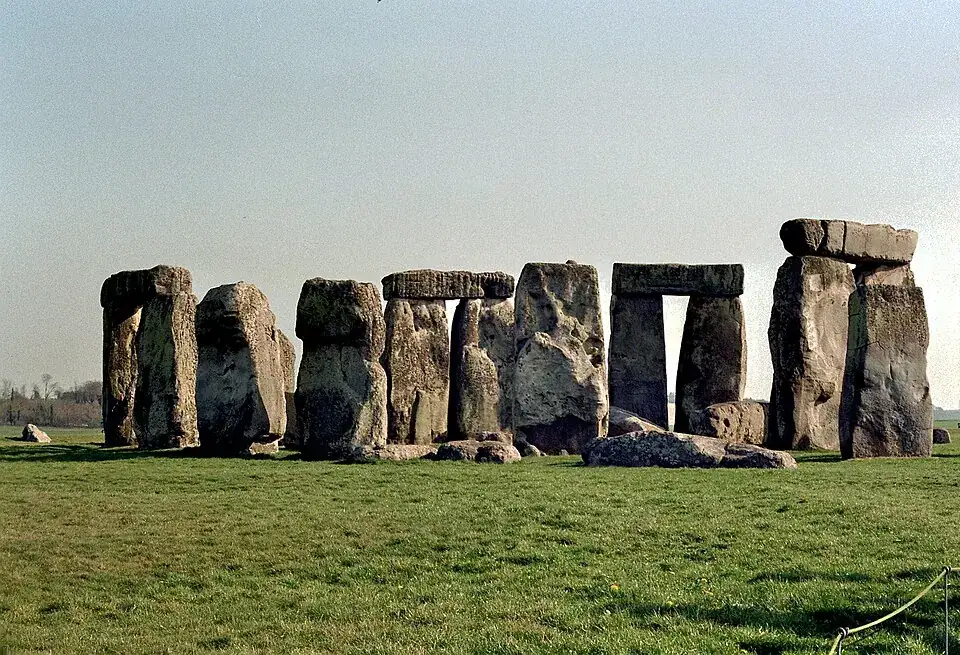
Around 2500 BCE Stonehenge entered its central stone phase.1 Large sarsen stones and smaller bluestones were raised to form an outer circle and inner trilithons.2 The work required many people to transport, shape and set the stones, and it tied the monument to a wider landscape of ceremonial use. Stonehenge became a place where astronomical alignments, ritual movement and collective labour came together. Its precise purpose remains debated, but the structure itself shows how prehistoric communities could coordinate large projects and mark time through the sky. The monument's later fame has made it a symbol of prehistory, even as scholars continue to test older assumptions about how and why it was built. Its stones still anchor debates about prehistoric engineering and belief.
Evidence ledger
3 claims2 sourced0 unsourced1 author judgment
Every hard fact in the narrative above is registered here. A claim may also record source-only details that the narrative does not repeat; the related-narrative line points to the corresponding passage, not a guarantee that the source supports every word of the body. A claim without a source stays visibly unsourced.
Around 2500 BCE Stonehenge entered its central stone phase.
Related narrativeAround 2500 BCE Stonehenge entered its central stone phase.
- Building StonehengeSection: The first monument
In about 2500 BC the site was transformed by the construction of the central stone settings.
Accessed 2026-11-09 · machine excerpt · pending human review
- Building StonehengeSection: The first monument
Large sarsen stones and smaller bluestones were raised to form an outer circle and inner trilithons.
Related narrativeLarge sarsen stones and smaller bluestones were raised to form an outer circle and inner trilithons.
- Building StonehengeSection: The first monument
Enormous sarsen stones and smaller bluestones were raised to form a unique monument.
Accessed 2026-11-09 · machine excerpt · pending human review - Stonehenge, Avebury and Associated SitesOutstanding Universal Value — Brief synthesis, paragraph on Stonehenge
uniquely using both Wiltshire Sarsen sandstone and Pembroke Bluestone
Accessed 2026-11-20 · machine excerpt · pending human review
- Building StonehengeSection: The first monument
The overall context of the event body.
Related narrativeAround 2500 BCE Stonehenge entered its central stone phase. Large sarsen stones and smaller bluestones were raised to form an outer circle and inner trilithons. The work required many people to transport, shape and set the stones, and it tied the monument to a wider landscape of ceremonial use. Stonehenge became a place where astronomical alignments, ritual movement and collective labour came together. Its precise purpose remains debated, but the structure itself shows how prehistoric communities could coordinate large projects and mark time through the sky. The monument's later fame has made it a symbol of prehistory, even as scholars continue to test older assumptions about how and why it was built. Its stones still anchor debates about prehistoric engineering and belief.
Editorial judgment, not a historical fact.
Author judgment covering the body context; not a factual source.
Sources and review
Cross-check · 2026-11-20 · UNESCO and English Heritage both support the use of sarsen and bluestone at Stonehenge and its construction from massive stones; the body adds no claim beyond these records.
- Building Stonehenge · English Heritage (accessed 2026-11-04) Original source ↗
- Stonehenge, Avebury and Associated Sites · UNESCO World Heritage Centre (accessed 2026-11-20) Original source ↗
Locations
- England· 51.18, -1.83· Approximate
evt-afe61703eebb11aeSource file:
events/evt-afe61703eebb11ae/event.md