
Refined at the event level; this event stays on its event page and has no separate curated story page.
The short version
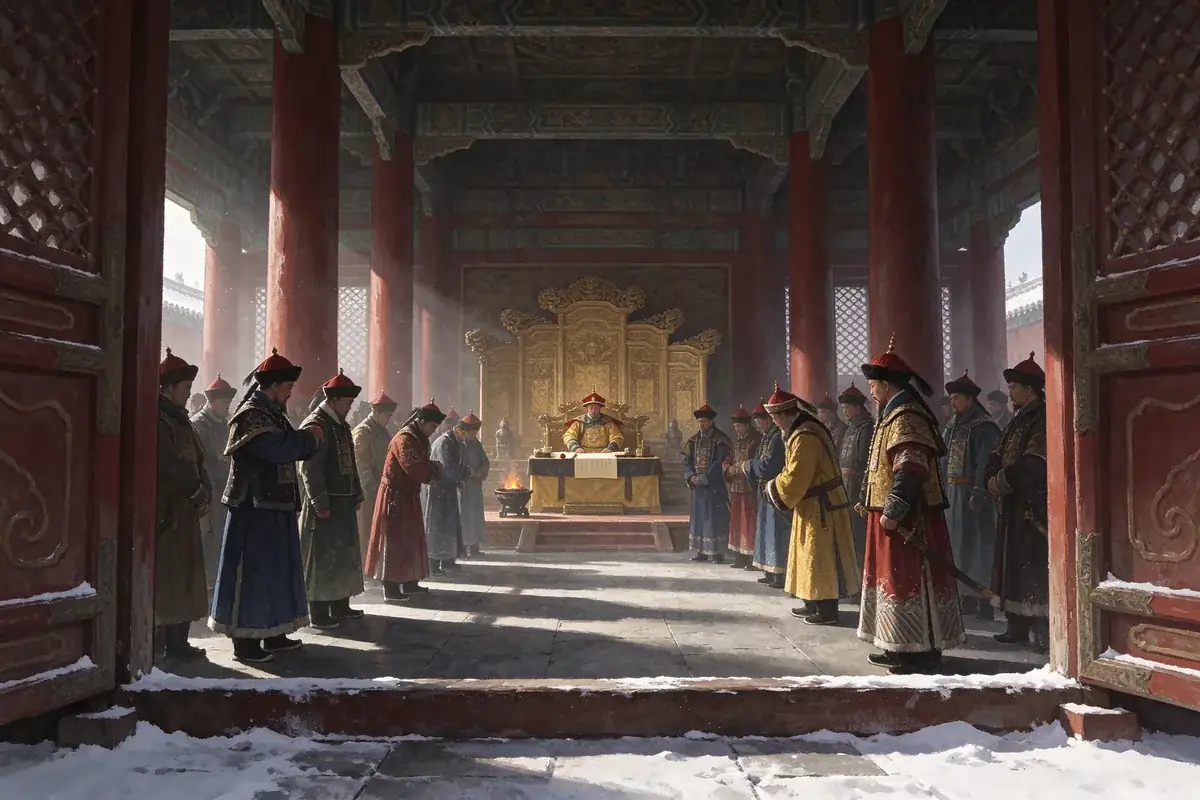
In 1636, in the palace at Shengjing (present-day Shenyang), Hong Taiji changed the state name from “Later Jin” to “Great Qing”. The legacy entry adds the Chongde reign title and a formal proclamation as emperor. The source sets the year in a larger frame: Hong Taiji became emperor of the Manchu, Mongols and Chinese in Manchuria, adopted the name Qing, led armies into Mongolia and Korea, and made both countries vassal states.
This was not a change of shop sign. For a regime moving from a tribal confederation toward an empire, the state name, the khan's title and the imperial title all announced something to insiders and outsiders: I am no longer only the khan of the Jurchens; I am the emperor of a multi-ethnic empire.
Why it happened
The legacy entry traces the background through Nurhaci's founding of the Later Jin and Hong Taiji's centralisation, his Six Ministries modelled on the Ming and his completion of the Eight Banners. The source does not itemise those institutions in the same passage. What it does confirm is that by 1636 Hong Taiji had placed himself at the centre of a Manchu, Mongol and Chinese order.
The name “Later Jin” carried historical weight: it recalled the Jurchen Jin dynasty and anchored the regime in Jurchen memory. But once Mongol tribes, Chinese banner troops and Korea were drawn in, a purely Jurchen identity was no longer enough. The new name had to answer a bigger question: who had the right to sit at the centre of this multi-ethnic order?
What happened
The source's wording matters: in 1636 Hong Taiji became emperor of “the Manchu, Mongols, and Chinese in Manchuria”. That does not mean he already ruled all of China. It means that in Manchuria he gathered three populations under one imperial title. The legacy entry also gives the fifth lunar month, Shengjing and the Chongde reign title; those details are not repeated in the same passage of the source and remain legacy copy on the page.
The change from “Later Jin” to “Qing” was not merely a matter of taboo or wording. It turned a regime that still invoked the memory of an older dynasty into a new dynasty with a new name. The name no longer spoke only to Jurchens; it spoke to Mongols, Chinese banner troops, Korea and the subjects of the Ming. Title, reign name and state name together reset the regime's political identity.
What changed
The Qing of 1636 had not yet entered Beijing. The source says Hong Taiji campaigned into Mongolia and Korea and made them vassals, preparing the way for the later conquest. The legacy entry describes the founding of the Qing as a transition from a regional power to a potential national dynasty. That transition was a direction, not a fact completed on the day. What made the Qing a national dynasty was the entry into Beijing in 1644 and the conquests that followed.
So 1636 looks more like an early coronation: the territory was still beyond the pass, but the title was already designed for a universal ruler. The name arrived first; the territory arrived later, across eight years of war, alliance and waiting.
How to read the evidence
This entry carries one source, Britannica's article on Abahai. It directly supports three points: in 1636 Hong Taiji became emperor of the Manchu, Mongols and Chinese; he adopted the name Qing; and he campaigned into Mongolia and Korea, making them vassal states. The fifth month, Shengjing, the Chongde reign title, the Six Ministries and the Eight Banners remain legacy copy; the source does not confirm them in the same passage.
Read it by separating “becoming emperor” from “unifying China”, and “state name” from “territory”. In 1636 the political name was upgraded; the unification of China still lay ahead. A name can be changed in a day; territory and institutions take years to catch up.
Sources behind this read
- Abahai · Encyclopaedia Britannica (accessed 2026-11-21) Original source ↗
Original entry and sentence-level review
In the fifth lunar month, Later Jin khan Hong Taiji, in Shenyang (Mukden), changed the state name from 'Later Jin' to 'Great Qing' and adopted the reign title 'Chongde', formally declaring himself emperor.1 The founding of the Qing dynasty marked the transition of the Manchu regime from a regional power to a potential national dynasty.2 Hong Taiji strengthened centralization, modeled the Six Ministries on the Ming system, and perfected the Eight Banners.3
Evidence ledger
3 claims1 sourced2 unsourced
Every hard fact in the narrative above is registered here. A claim may also record source-only details that the narrative does not repeat; the related-narrative line points to the corresponding passage, not a guarantee that the source supports every word of the body. A claim without a source stays visibly unsourced.
In the fifth lunar month, Later Jin khan Hong Taiji, in Shenyang (Mukden), changed the state name from 'Later Jin' to 'Great Qing' and adopted the reign title 'Chongde', formally declaring himself emperor.
Related narrativeIn the fifth lunar month, Later Jin khan Hong Taiji, in Shenyang (Mukden), changed the state name from 'Later Jin' to 'Great Qing' and adopted the reign title 'Chongde', formally declaring himself emperor.
- AbahaiOpening article paragraphs
Abahai (born Nov. 28, 1592, Manchuria—died Sept. 21, 1643, Manchuria) Manchurian tribal leader who in 1636 became emperor of the Manchu, Mongols, and Chinese in Manchuria. In addition, for his family he adopted the name of Qing (“Pure”), which also became the name of the Chinese dynasty. He led armies into Mongolia and Korea and made those countries vassal states of the Manchu.
Accessed 2026-11-21 · machine excerpt · pending human review
Bulk context rewrite; sources pending
- AbahaiOpening article paragraphs
The founding of the Qing dynasty marked the transition of the Manchu regime from a regional power to a potential national dynasty.
Related narrativeThe founding of the Qing dynasty marked the transition of the Manchu regime from a regional power to a potential national dynasty.
No source registered. This assertion remains unverified.
Bulk context rewrite; sources pending
Hong Taiji strengthened centralization, modeled the Six Ministries on the Ming system, and perfected the Eight Banners.
Related narrativeHong Taiji strengthened centralization, modeled the Six Ministries on the Ming system, and perfected the Eight Banners.
No source registered. This assertion remains unverified.
Bulk context rewrite; sources pending
Sources and review
English translation predates the current source revision; 2 key claims have no binding source; Unsourced key claims keep the event at structure level
- Abahai · Encyclopaedia Britannica (accessed 2026-11-21) Original source ↗
Locations
- Qing Empire· 41.8, 123.4· Approximate
evt-af45a63e767146f8Source file:
events/evt-af45a63e767146f8/event.md