
Refined at the event level; this event stays on its event page and has no separate curated story page.
The short version
The legacy entry puts the fall in June 1402: the prince of Yan's army crosses the Yangtze, a gate opens from inside, the palace burns, and the emperor is gone. The source is more cautious. It gives the year 1402, but not the month, the gate or the man who opened it. The skeleton it does support is this: Jianwen tries to cut the princes down to size, the prince of Yan rebels, Nanjing falls in 1402, Jianwen vanishes when his palace burns, and the prince becomes the Yongle Emperor.
Why it happened
Zhu Yuanzhang died and his grandson Zhu Yunwen took the throne. The young emperor inherited not a circle of obedient uncles but a ring of princes with troops. Jianwen tried to reassert central control; the prince of Yan refused to hand over his power. The source states the origin of the war plainly: Jianwen tried to reassert control over several princedoms ruled by his uncles, the prince of Yan rose in rebellion, and his troops overwhelmed the capital in 1402.
The legacy entry adds the longer campaign: years of civil war, a Yan defeat at Dongchang, and Nanjing finally opened at Jinchuan Gate. Those details belong to the legacy war narrative, not to the sentence this entry attaches to a source. What the source supports is the causal spine: centralisation provokes rebellion, and the rebel army takes the capital.
What happened
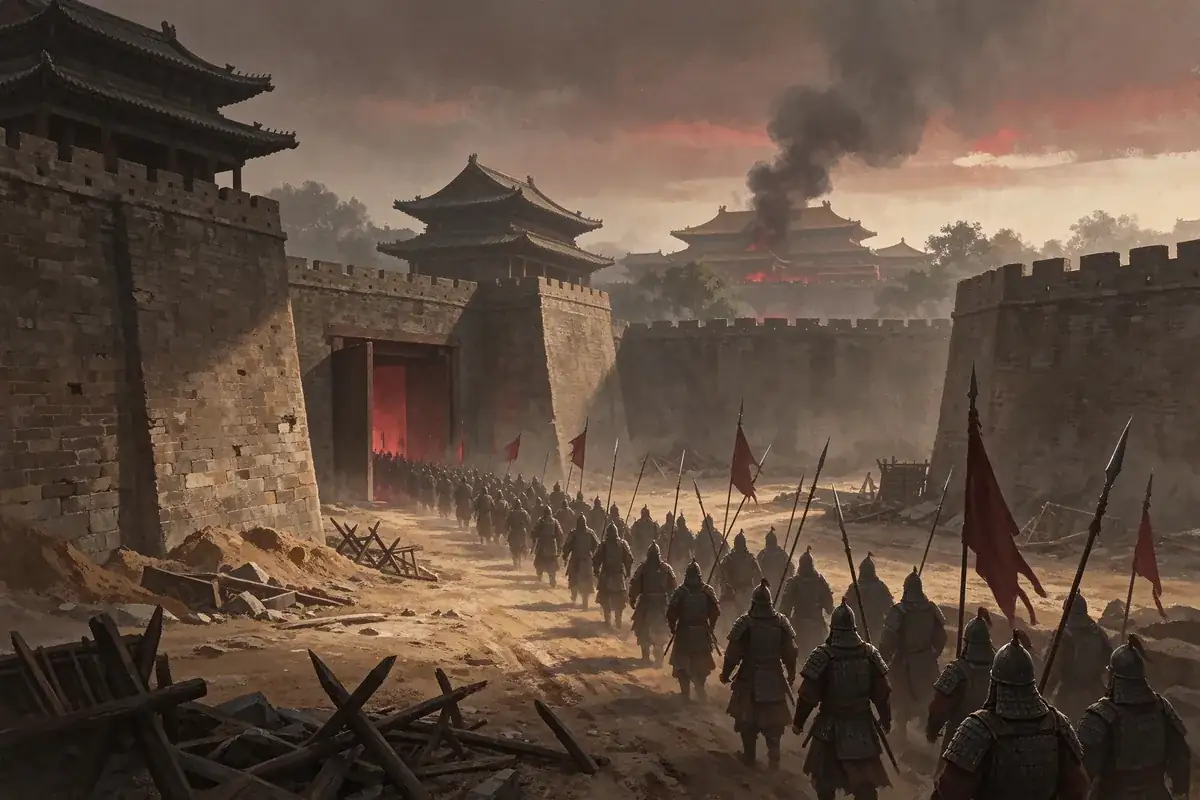
At the fall of Nanjing, the source leaves one tight sentence: the palace was burned, and the defeated Jianwen vanished at that moment. The legacy entry fills in the scene: Li Jinglong opens Jinchuan Gate and surrenders, Yan troops enter, the palace catches fire, and some say Jianwen died in the flames while others say he shaved his head, became a monk and escaped through a water gate.
Two kinds of material need separating here. The gate and the burning are legacy narrative; Jianwen's disappearance is the core the source also acknowledges. Whether he died, and if not where he went, the source does not answer. The legacy entry's “died in the fire” and “escaped as a monk” are two stories standing side by side, not two verified depositions.
What changed
Zhu Di took the throne in 1402 and adopted the reign name Yongle. That is what the source confirms. The legacy entry then describes the purge of Jianwen's loyalists: Fang Xiaoru refused to draft the accession edict and was executed with his extended family; Qi Tai and Huang Zicheng were killed. Those names and the “ten households” tradition are among the sharpest later narratives, but the attached source does not support them item by item. They can show the political hostility the new emperor faced; they cannot be treated as an audited list of the dead.
One emperor disappears and another takes the throne. The hard problem is not on the battlefield but in legitimacy. Zhu Di needs to turn the Jianwen reign into an interlude that can be erased, while preventing the rumour that Jianwen is still alive from becoming a legitimate rallying cry. The legacy entry calls the disappearance the greatest mystery of the Ming; that is a later label, not a line in the source. The mystery is dark partly because the evidence is thin, and partly because the politics of the day did not allow it to be cleared up.
How to read the evidence
This entry carries one source, Britannica's “Jianwen”. It directly supports the spine: the attempt to reduce the princes, the Yan rebellion, the fall of Nanjing in 1402, Jianwen's disappearance when the palace burned, and Zhu Di's accession as the Yongle Emperor. The month, Jinchuan Gate, Li Jinglong, Fang Xiaoru and the “ten households” story remain legacy copy pending further research; the page keeps the “legacy copy · source pending” label.
Read it by separating “who won” from “who died”. The accession has a clear year. How Jianwen died, or whether he died at all, is not answered by the source. Do not turn a later loyalist story into a contemporary archive, and do not let the word “mystery” stand in for evidence.
Sources behind this read
- Jianwen · Encyclopaedia Britannica (accessed 2026-11-21) Original source ↗
Original entry and sentence-level review
In June 1402, the Yan prince Zhu Di crossed the Yangtze River and approached Nanjing.1 The defending general Li Jinglong opened the Jinchuan Gate and surrendered, allowing Zhu Di's army to enter the city.2 The imperial palace caught fire, and the Jianwen Emperor Zhu Yunwen was never seen again – some say he died in the flames, others that he escaped disguised as a monk.3 On July 17, Zhu Di ascended the throne with the era name Yongle, becoming the Yongle Emperor.4 He brutally purged Jianwen's loyalists; Fang Xiaoru, who refused to draft the abdication edict, was executed with his entire extended family.5 The disappearance of the Jianwen Emperor remains the greatest mystery of the Ming dynasty.6
Evidence ledger
6 claims1 sourced5 unsourced
Every hard fact in the narrative above is registered here. A claim may also record source-only details that the narrative does not repeat; the related-narrative line points to the corresponding passage, not a guarantee that the source supports every word of the body. A claim without a source stays visibly unsourced.
In June 1402, the Yan prince Zhu Di crossed the Yangtze River and approached Nanjing.
Related narrativeIn June 1402, the Yan prince Zhu Di crossed the Yangtze River and approached Nanjing.
No source registered. This assertion remains unverified.
Bulk context rewrite; sources pending
The defending general Li Jinglong opened the Jinchuan Gate and surrendered, allowing Zhu Di's army to enter the city.
Related narrativeThe defending general Li Jinglong opened the Jinchuan Gate and surrendered, allowing Zhu Di's army to enter the city.
No source registered. This assertion remains unverified.
Bulk context rewrite; sources pending
The imperial palace caught fire, and the Jianwen Emperor Zhu Yunwen was never seen again – some say he died in the flames, others that he escaped disguised as a monk.
Related narrativeThe imperial palace caught fire, and the Jianwen Emperor Zhu Yunwen was never seen again – some say he died in the flames, others that he escaped disguised as a monk.
- JianwenArticle body, final paragraph
He met his downfall when he tried to reassert central control over several princedoms within the empire that were ruled by his uncles. This effort provoked a rebellion by his uncle the prince of Yan, whose troops overwhelmed the capital in 1402 and established him as the Yongle emperor (reigned 1402–24); the defeated Jianwen vanished at the time his palace was burned.
Accessed 2026-11-21 · machine excerpt · pending human review
Bulk context rewrite; sources pending
- JianwenArticle body, final paragraph
On July 17, Zhu Di ascended the throne with the era name Yongle, becoming the Yongle Emperor.
Related narrativeOn July 17, Zhu Di ascended the throne with the era name Yongle, becoming the Yongle Emperor.
No source registered. This assertion remains unverified.
Bulk context rewrite; sources pending
He brutally purged Jianwen's loyalists; Fang Xiaoru, who refused to draft the abdication edict, was executed with his entire extended family.
Related narrativeHe brutally purged Jianwen's loyalists; Fang Xiaoru, who refused to draft the abdication edict, was executed with his entire extended family.
No source registered. This assertion remains unverified.
Bulk context rewrite; sources pending
The disappearance of the Jianwen Emperor remains the greatest mystery of the Ming dynasty.
Related narrativeThe disappearance of the Jianwen Emperor remains the greatest mystery of the Ming dynasty.
No source registered. This assertion remains unverified.
Bulk context rewrite; sources pending
Sources and review
English translation predates the current source revision; 5 key claims have no binding source; Unsourced key claims keep the event at structure level
- Jianwen · Encyclopaedia Britannica (accessed 2026-11-21) Original source ↗
Locations
- Ming· 32.06, 118.78· Approximate
evt-ae59b70d17c3e39bSource file:
events/evt-ae59b70d17c3e39b/event.md