
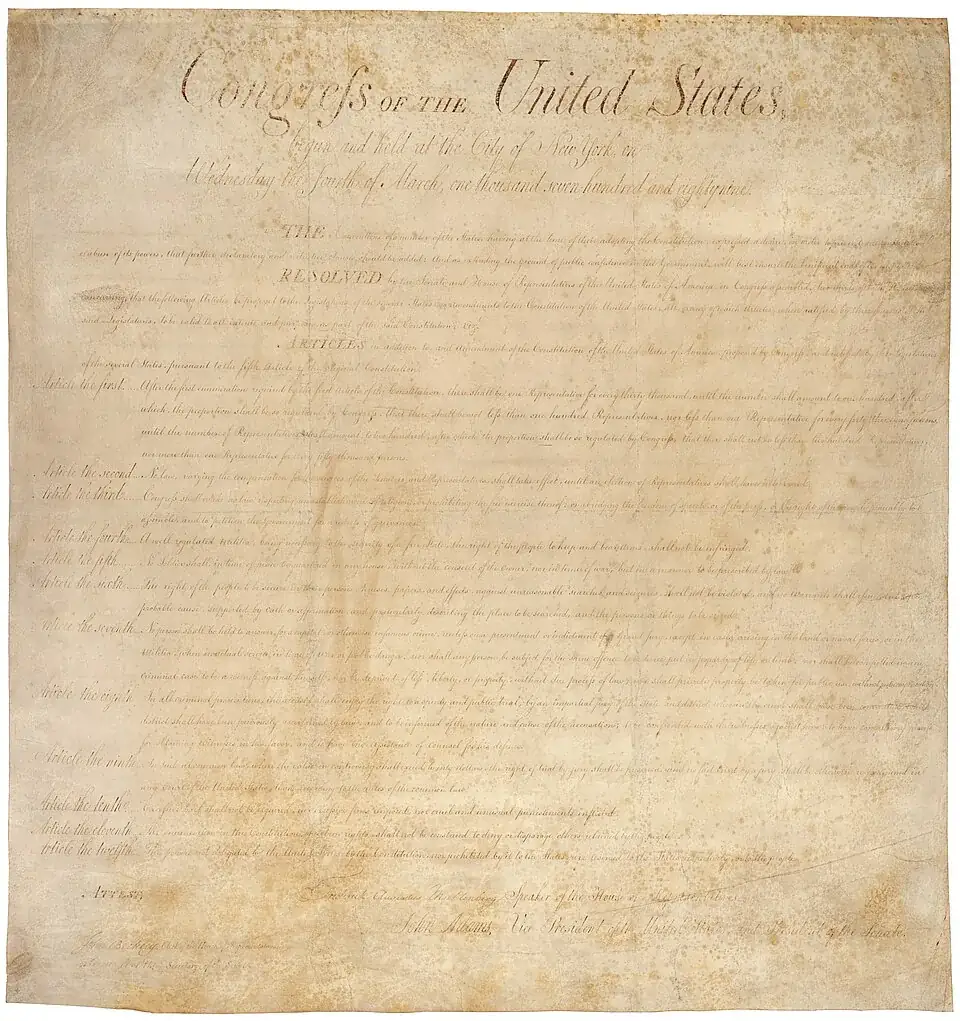
The U.S.1 Congress adopts the first ten amendments to the Constitution, collectively known as the Bill of Rights. The amendments guarantee: freedom of speech, press, assembly, petition, and religion; the right to bear arms; protection against quartering of soldiers (Third Amendment); protection against unreasonable searches and seizures; rights of criminal defendants (protection against self-incrimination, right to a fair and speedy jury trial, double jeopardy); protection against cruel and unusual punishment; and reserving to the states or the people powers not delegated to the federal government. The amendments take effect on December 15, 1791.1
Evidence ledger
1 claims1 sourced0 unsourced
Every hard fact in the narrative above is registered here. A claim may also record source-only details that the narrative does not repeat; the related-narrative line points to the corresponding passage, not a guarantee that the source supports every word of the body. A claim without a source stays visibly unsourced.
- Bill of RightsOpening paragraph and sections on First, Second, Fourth, and Sixth Amendments
Bill of Rights ... the first 10 amendments to the U.S. Constitution, which were adopted as a single unit on December 15, 1791 ... Under the First Amendment ... freedom of speech or press ... Second Amendment ... right to bear arms ... Fourth Amendment secures the people against unreasonable searches and seizures ... Sixth Amendment ... speedy public trial by jury ...
Accessed 2026-11-21 · machine excerpt · pending human review
Whole-body alignment; bulk context rewrite
- Bill of RightsOpening paragraph and sections on First, Second, Fourth, and Sixth Amendments
Sources and review
English translation predates the current source revision; Key claims rely on a single source record
- Bill of Rights · Encyclopaedia Britannica (accessed 2026-11-21) Original source ↗
Locations
- United States· 38.9, -77.04· Approximate
evt-769d5b95ce7208b8Source file:
events/evt-769d5b95ce7208b8/event.md