
Refined at the event level; this event stays on its event page and has no separate curated story page.
The short version
In 1406 the Yongle Emperor ordered a new imperial palace in Beijing. By 1420 the court had moved in. Those two dates are the skeleton directly supported by Britannica's “Forbidden City”. A palace, however, does not grow out of a decree. It rests on legitimacy, frontier defence, timber, stone and the hands of tens of thousands of people.
Why it happened
Zhu Di took the throne through the Jingnan campaign. The legacy record places this in the “Founding and Yongle ascendancy” phase: Zhu Yuanzhang expelled the Mongols and abolished the chancellorship; Zhu Di moved the capital to Beijing, commissioned the Yongle Encyclopedia and sent Zheng He across the Indian Ocean. Nanjing was the old capital; Beijing was the political centre Zhu Di wanted to reorganise. Moving the court north put it closer to the northern frontier and bound the new emperor's followers, old officials and regional resources into one network. Building the Forbidden City was the most expensive, most visible move in that shift.
What happened
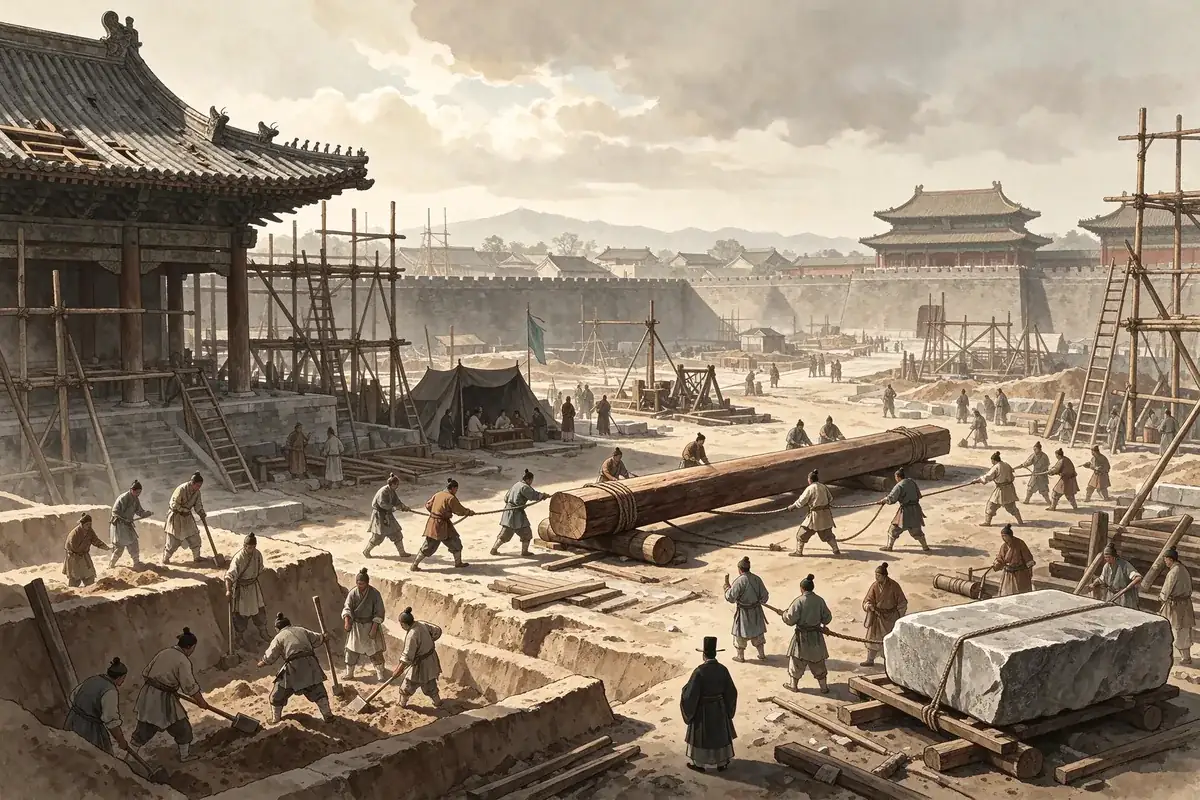
The source-backed core is narrow: the 1406 commission and the 1420 completion and occupation. Over those fourteen years, the legacy record adds a fuller picture: the plan followed Nanjing but was larger; the architects included Cai Xin and Wu Zhong; some 300,000 craftsmen and 1 million labourers were mobilised; nanmu timber came from the deep forests of Sichuan, Huguang and Jiangxi, and stone from Fangshan near Beijing.
Pause here. Britannica does not support each of those figures and names item by item. They are legacy engineering narrative, not audited accounts. What can be put on paper is the sequence: commission, construction, occupation in 1420. The daily life of the site — how many people, how timber moved, how earth was rammed in winter — is not preserved in the legacy record, and we do not invent it.
What changed
After the court moved in in 1420, the palace became the Ming imperial residence; the Qing continued to use it after 1644. The second sentence is a general historical account, not a claim in this entry. The complex packed emperor, bureaucracy, ceremony and daily administration into one walled space: a central axis, gates, courts and the separation of outer court and inner quarters. Beijing's urban order grew around it, and the Palace Museum remains the city's most visible historical landmark.
The phrase “the world's most magnificent palace complex” is a later appraisal. The source supports the dates of construction and occupation, not that superlative.
How to read the evidence
The entry has one attached source, Britannica's “Forbidden City”, which directly supports the claim that the palace was commissioned in 1406 and largely completed by 1420. The architects, the 300,000 craftsmen, the 1 million labourers and the timber sources remain legacy copy pending further research; the page keeps the “legacy copy · source pending” label. Separate the chronological skeleton from the engineering detail: the first is sourced, the second still needs evidence. Do not treat scale as proof, and do not turn a later compliment into a contemporary record.
Sources behind this read
- Forbidden City · Encyclopaedia Britannica (accessed 2026-11-21) Original source ↗
Original entry and sentence-level review
The Yongle Emperor ordered the formal construction of the imperial palace in Beijing.1,2 The plan was modeled on Nanjing but on a larger scale. Architects included Cai Xin and Wu Zhong, mobilizing 300,000 craftsmen and 1 million laborers across the country. Timber came from deep forests in Sichuan, Huguang, and Jiangxi; stone was quarried from Fangshan near Beijing. The Forbidden City was largely completed in 1420, becoming the world's most magnificent palace complex.1
Evidence ledger
2 claims1 sourced1 unsourced
Every hard fact in the narrative above is registered here. A claim may also record source-only details that the narrative does not repeat; the related-narrative line points to the corresponding passage, not a guarantee that the source supports every word of the body. A claim without a source stays visibly unsourced.
The Yongle Emperor ordered the formal construction of the imperial palace in Beijing. The plan was modeled on Nanjing but on a larger scale. Architects included Cai Xin and Wu Zhong, mobilizing 300,000 craftsmen and 1 million laborers across the country. Timber came from deep forests in Sichuan, Huguang, and Jiangxi; stone was quarried from Fangshan near Beijing. The Forbidden City was largely completed in 1420, becoming the world's most magnificent palace complex. For Asia in 1406, “Construction of the Forbidden City begins in Beijing” is a traceable node of Engineering change whose significance is best read through later events.
Related narrativeThe Yongle Emperor ordered the formal construction of the imperial palace in Beijing. The plan was modeled on Nanjing but on a larger scale. Architects included Cai Xin and Wu Zhong, mobilizing 300,000 craftsmen and 1 million laborers across the country. Timber came from deep forests in Sichuan, Huguang, and Jiangxi; stone was quarried from Fangshan near Beijing. The Forbidden City was largely completed in 1420, becoming the world's most magnificent palace complex.
No source registered. This assertion remains unverified.
Whole-body alignment; bulk context rewrite
In 1406 the Yongle emperor commissioned the imperial palace in Beijing; construction was largely completed by 1420, producing the complex later known as the Forbidden City.
Related narrativeThe Yongle Emperor ordered the formal construction of the imperial palace in Beijing.
- Forbidden CityOpening paragraph and Quick Facts “Built: 1406–20”
Commissioned in 1406 by the Yongle emperor of the Ming dynasty, it was first officially occupied by the court in 1420. Built: 1406–20. Built by: Yongle emperor (Ming dynasty).
Accessed 2026-11-21 · machine excerpt · pending human review
The source records the Yongle emperor's commission in 1406 and the court's first official occupation in 1420, with Quick Facts giving Built 1406–20; the event adds the Nanjing model, Cai Xin and Wu Zhong as architects, 300,000 craftsmen and 1 million laborers, timber from Sichuan, Huguang, and Jiangxi, and stone from Fangshan, none of which is supported in the same passage, so the claim keeps only the 1406 commission and 1420 completion.
- Forbidden CityOpening paragraph and Quick Facts “Built: 1406–20”
Sources and review
English translation predates the current source revision; 1 key claims have no binding source; Unsourced key claims keep the event at structure level
- Forbidden City · Encyclopaedia Britannica (accessed 2026-11-21) Original source ↗
Locations
- Ming· 39.92, 116.39· Approximate
evt-5c3a67de1f3a3d09Source file:
events/evt-5c3a67de1f3a3d09/event.md