
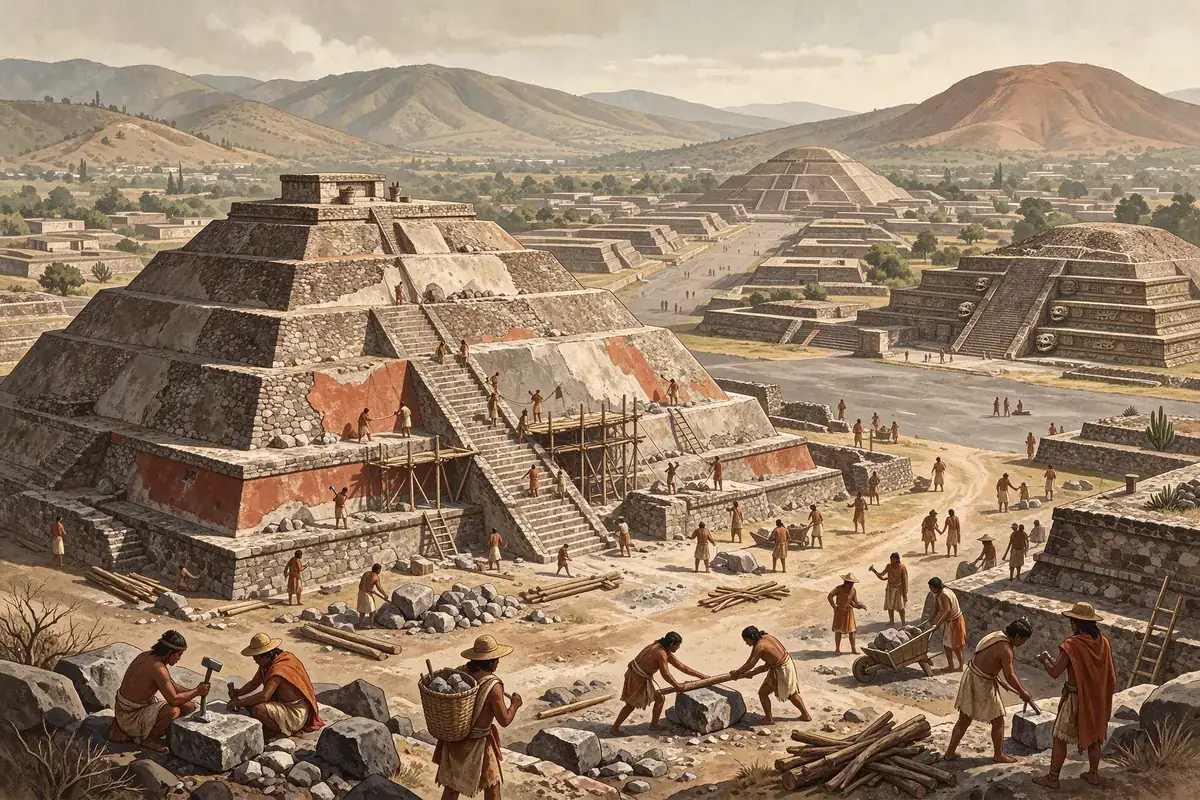
Teotihuacan, located 50 km northeast of modern Mexico City, was at its height from the 1st to 7th centuries AD.1 Around 220 AD, the city's population exceeded 100,000, covering 20 square kilometers, making it the largest city in Mesoamerica.2 The Sun Pyramid was expanded for the third time, reaching a height of 65 meters; the Moon Pyramid and the Temple of the Feathered Serpent were also built.3 Teotihuacan controlled all of Mesoamerica through obsidian trade, and its art and architecture influenced later Maya and Aztec civilizations.4
Evidence ledger
4 claims1 sourced3 unsourced
Every hard fact in the narrative above is registered here. A claim may also record source-only details that the narrative does not repeat; the related-narrative line points to the corresponding passage, not a guarantee that the source supports every word of the body. A claim without a source stays visibly unsourced.
No source registered. This assertion remains unverified.
Bulk context rewrite; sources pending
Around 220 AD, the city's population exceeded 100,000, covering 20 square kilometers, making it the largest city in Mesoamerica.
Related narrativeAround 220 AD, the city's population exceeded 100,000, covering 20 square kilometers, making it the largest city in Mesoamerica.
- TeotihuacánOpening paragraph
At its apogee (c. 500 ce), it encompassed some 8 square miles (20 square km) and supported a population estimated at 125,000–200,000, making it, at the time, one of the largest cities in the world. ... The pyramid rises 216 feet (66 metres) above ground level.
Accessed 2026-11-21 · machine excerpt · pending human review
Bulk context rewrite; sources pending
- TeotihuacánOpening paragraph
The Sun Pyramid was expanded for the third time, reaching a height of 65 meters; the Moon Pyramid and the Temple of the Feathered Serpent were also built.
Related narrativeThe Sun Pyramid was expanded for the third time, reaching a height of 65 meters; the Moon Pyramid and the Temple of the Feathered Serpent were also built.
No source registered. This assertion remains unverified.
Bulk context rewrite; sources pending
Teotihuacan controlled all of Mesoamerica through obsidian trade, and its art and architecture influenced later Maya and Aztec civilizations.
Related narrativeTeotihuacan controlled all of Mesoamerica through obsidian trade, and its art and architecture influenced later Maya and Aztec civilizations.
No source registered. This assertion remains unverified.
Bulk context rewrite; sources pending
Sources and review
English translation predates the current source revision; 3 key claims have no binding source; Unsourced key claims keep the event at structure level
- Teotihuacán · Encyclopaedia Britannica (accessed 2026-11-21) Original source ↗
Locations
- Teotihuacan· 19.7, -98.9· Approximate
evt-43b7663af6506079Source file:
events/evt-43b7663af6506079/event.md