
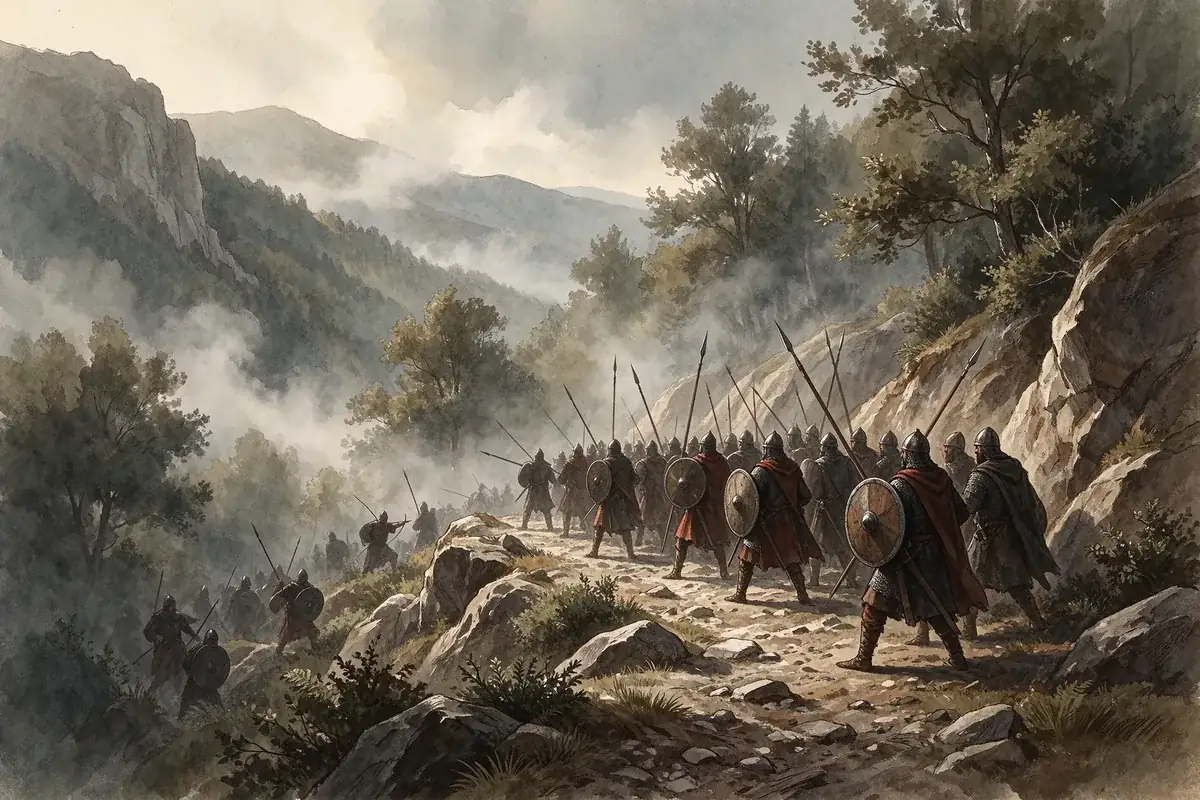
In 778 Charlemagne answered an appeal from Sulayman al-Arabi, governor of Zaragoza, and led two armies over the Pyrenees to join before the city.1 Sulayman then changed sides and shut the gates; unable to take Zaragoza, Charlemagne turned back, razing the walls of Pamplona on the way.2 On 15 August his rearguard was ambushed and annihilated by Basques in the pass of Roncesvalles, where Roland, warden of the Breton march, was killed.3 300 years later the defeat was transfigured into the Song of Roland, the earliest French chanson de geste.4 Charlemagne thereafter went on the defensive, gradually organising the Spanish March along the southern slopes of the Pyrenees.5
Evidence ledger
5 claims1 sourced4 unsourced
Every hard fact in the narrative above is registered here. A claim may also record source-only details that the narrative does not repeat; the related-narrative line points to the corresponding passage, not a guarantee that the source supports every word of the body. A claim without a source stays visibly unsourced.
No source registered. This assertion remains unverified.
Number presentation normalized; sources pending
Sulayman then changed sides and shut the gates; unable to take Zaragoza, Charlemagne turned back, razing the walls of Pamplona on the way.
Related narrativeSulayman then changed sides and shut the gates; unable to take Zaragoza, Charlemagne turned back, razing the walls of Pamplona on the way.
No source registered. This assertion remains unverified.
Number presentation normalized; sources pending
On 15 August his rearguard was ambushed and annihilated by Basques in the pass of Roncesvalles, where Roland, warden of the Breton march, was killed.
Related narrativeOn 15 August his rearguard was ambushed and annihilated by Basques in the pass of Roncesvalles, where Roland, warden of the Breton march, was killed.
- RoncesvallesSection: Roncesvalles: Charlemagne's Chapel, paragraph 1
This pass is the traditional site of the Battle of Roncesvalles (August 15, 778), in which the Basques ambushed and totally wiped out the rear guard of the Frankish army as it was returning across the mountains to Aquitaine after Charlemagne, campaigning against the Muslims in Spain, ravaged several towns south of the Pyrenees and razed Pamplona. The Frankish army was led by the seneschal Eggihard, the count palatine Anselm, and Roland, prefect of the March of Brittany.
Accessed 2026-11-21 · machine excerpt · pending human review
Number presentation normalized; sources pending
- RoncesvallesSection: Roncesvalles: Charlemagne's Chapel, paragraph 1
300 years later the defeat was transfigured into the Song of Roland, the earliest French chanson de geste.
Related narrative300 years later the defeat was transfigured into the Song of Roland, the earliest French chanson de geste.
No source registered. This assertion remains unverified.
Number presentation normalized; sources pending
Charlemagne thereafter went on the defensive, gradually organising the Spanish March along the southern slopes of the Pyrenees.
Related narrativeCharlemagne thereafter went on the defensive, gradually organising the Spanish March along the southern slopes of the Pyrenees.
No source registered. This assertion remains unverified.
Number presentation normalized; sources pending
Sources and review
English translation predates the current source revision; 4 key claims have no binding source; Unsourced key claims keep the event at structure level
- Roncesvalles · Encyclopaedia Britannica (accessed 2026-11-21) Original source ↗
Locations
- Frankish Kingdom· 42.8, -1.3· Approximate
evt-40c4998506bdb691Source file:
events/evt-40c4998506bdb691/event.md