
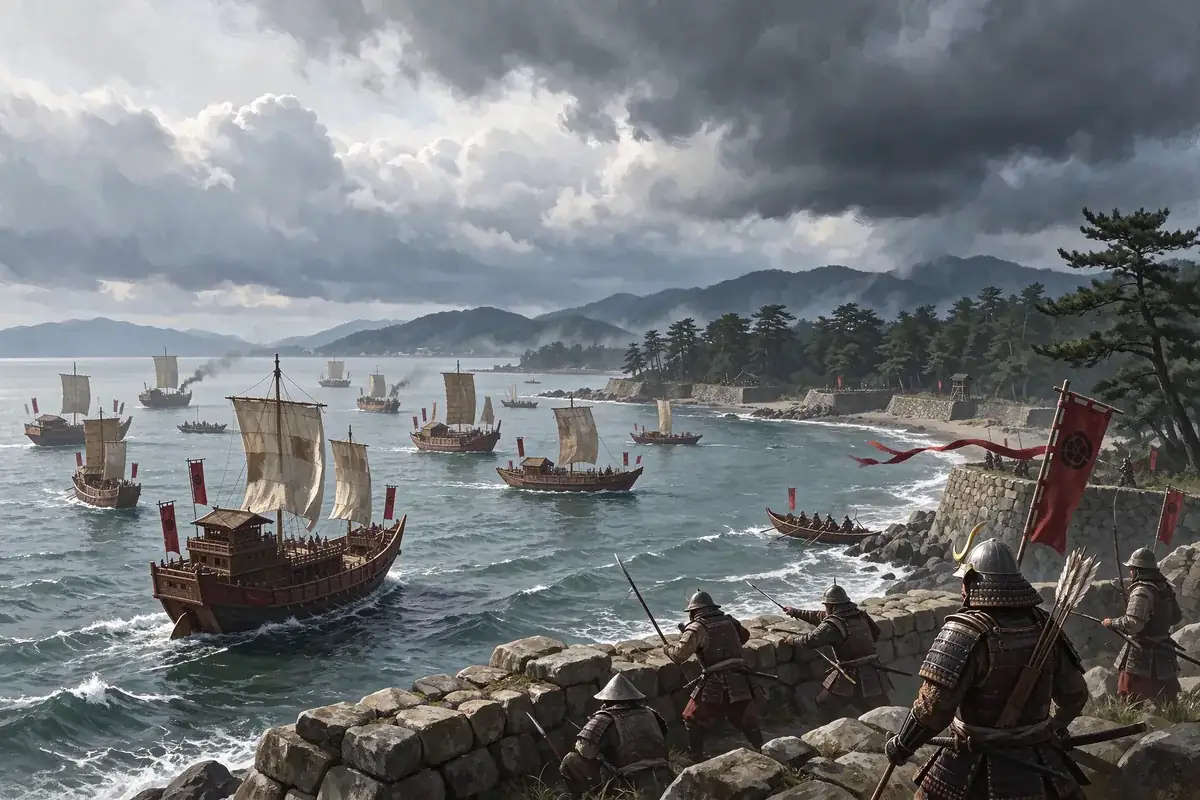
Kublai sent a Mongol-Han-Korean army of about 40,000 under Xin Du and Hong Cha-qiu to invade Japan from the Korean Peninsula.1 The Yuan army landed at Hakata Bay in northern Kyushu, using gunpowder weapons and counterweight trebuchets against the Japanese.2 The Japanese, inexperienced against such weapons, initially suffered losses.3 However, a typhoon struck that night, destroying most of the Yuan fleet, forcing a retreat.4 The Japanese called the typhoon 'kamikaze' (divine wind).5
Evidence ledger
5 claims1 sourced4 unsourced
Every hard fact in the narrative above is registered here. A claim may also record source-only details that the narrative does not repeat; the related-narrative line points to the corresponding passage, not a guarantee that the source supports every word of the body. A claim without a source stays visibly unsourced.
- Kamikaze of 1274 and 1281Opening paragraph
The first invasion force that attacked Japan in the autumn of 1274 comprised about 30,000 to 40,000 men ... and an estimated 500 to 900 vessels. The typhoon struck as the ships lay at anchor in Hakata Bay, Kyushu, Japan, sinking about one-third of them, with the rest limping home; it is estimated that 13,000 of Kublai’s men drowned.
Accessed 2026-11-21 · machine excerpt · pending human review
Bulk context rewrite; sources pending
- Kamikaze of 1274 and 1281Opening paragraph
The Yuan army landed at Hakata Bay in northern Kyushu, using gunpowder weapons and counterweight trebuchets against the Japanese.
Related narrativeThe Yuan army landed at Hakata Bay in northern Kyushu, using gunpowder weapons and counterweight trebuchets against the Japanese.
No source registered. This assertion remains unverified.
Bulk context rewrite; sources pending
The Japanese, inexperienced against such weapons, initially suffered losses.
Related narrativeThe Japanese, inexperienced against such weapons, initially suffered losses.
No source registered. This assertion remains unverified.
Bulk context rewrite; sources pending
However, a typhoon struck that night, destroying most of the Yuan fleet, forcing a retreat.
Related narrativeHowever, a typhoon struck that night, destroying most of the Yuan fleet, forcing a retreat.
No source registered. This assertion remains unverified.
Bulk context rewrite; sources pending
The Japanese called the typhoon 'kamikaze' (divine wind).
Related narrativeThe Japanese called the typhoon 'kamikaze' (divine wind).
No source registered. This assertion remains unverified.
Bulk context rewrite; sources pending
Sources and review
English translation predates the current source revision; 4 key claims have no binding source; Unsourced key claims keep the event at structure level
- Kamikaze of 1274 and 1281 · Encyclopaedia Britannica (accessed 2026-11-21) Original source ↗
Locations
- Yuan· 33.6, 130.4· Approximate
evt-2aa149464837ca03Source file:
events/evt-2aa149464837ca03/event.md