
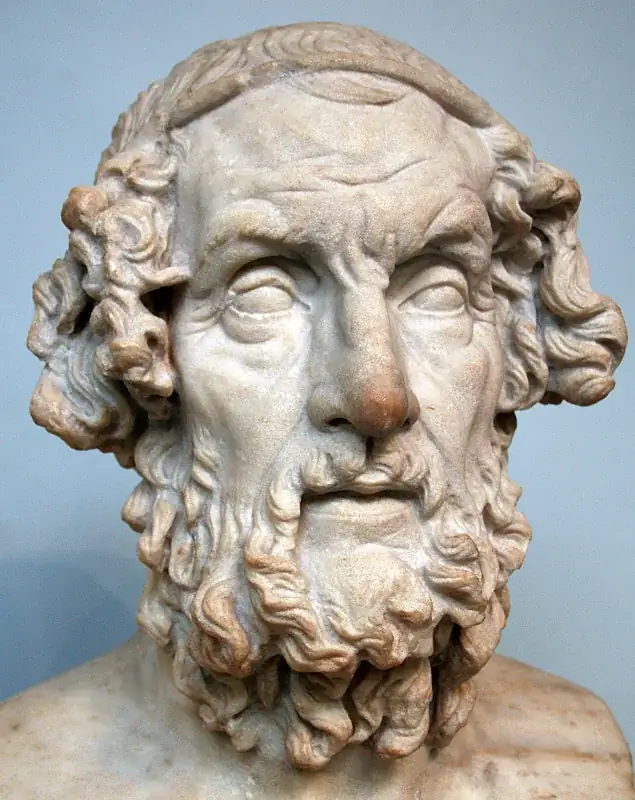
Around the mid-to-late 8th century BCE the Greek poet Homer, building on a long tradition of oral epic poetry, compiled and finalised the Iliad and the Odyssey.1 The Iliad recounts the wrath of Achilles and the heroic deeds of the Trojan War, while the Odyssey narrates Odysseus's decade of wandering and his return home.2 The Greek alphabet, newly adapted from Phoenician script, made it possible for these long recited poems to be set down in writing for the first time.3 The two epics are the fountainhead of Western literature and a rich source for Greek mythology, religion, society and moral thought.4
Evidence ledger
4 claims1 sourced3 unsourced
Every hard fact in the narrative above is registered here. A claim may also record source-only details that the narrative does not repeat; the related-narrative line points to the corresponding passage, not a guarantee that the source supports every word of the body. A claim without a source stays visibly unsourced.
- HomerOpening section and Dating the works
Homer (flourished 9th or 8th century bce?, Ionia?) was the presumed author of the Iliad and the Odyssey. ... it seems plausible to conclude that the period of composition of the large-scale epics ... was the 9th or 8th century, with several features pointing more clearly to the 8th. The Odyssey may belong near the end of this century, the Iliad closer to its middle.
Accessed 2026-11-21 · machine excerpt · pending human review
Bulk context rewrite; sources pending
- HomerOpening section and Dating the works
The Iliad recounts the wrath of Achilles and the heroic deeds of the Trojan War, while the Odyssey narrates Odysseus's decade of wandering and his return home.
Related narrativeThe Iliad recounts the wrath of Achilles and the heroic deeds of the Trojan War, while the Odyssey narrates Odysseus's decade of wandering and his return home.
No source registered. This assertion remains unverified.
Bulk context rewrite; sources pending
The Greek alphabet, newly adapted from Phoenician script, made it possible for these long recited poems to be set down in writing for the first time.
Related narrativeThe Greek alphabet, newly adapted from Phoenician script, made it possible for these long recited poems to be set down in writing for the first time.
No source registered. This assertion remains unverified.
Bulk context rewrite; sources pending
The two epics are the fountainhead of Western literature and a rich source for Greek mythology, religion, society and moral thought.
Related narrativeThe two epics are the fountainhead of Western literature and a rich source for Greek mythology, religion, society and moral thought.
No source registered. This assertion remains unverified.
Bulk context rewrite; sources pending
Sources and review
English translation predates the current source revision; 3 key claims have no binding source; Unsourced key claims keep the event at structure level
- Homer · Encyclopaedia Britannica (accessed 2026-11-21) Original source ↗
Locations
- Greece· 38.42, 26.13· Approximate
evt-287114710768472fSource file:
events/evt-287114710768472f/event.md