
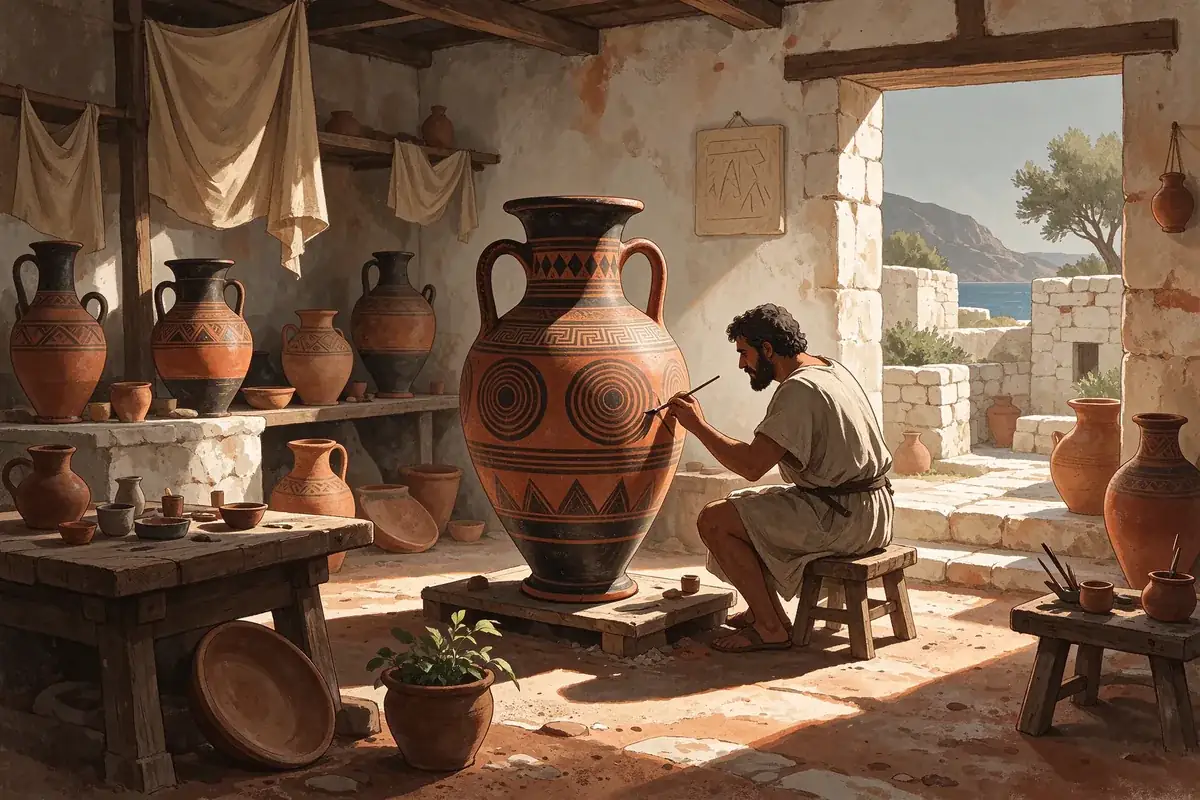
A new geometric pattern style of pottery appeared in Athens and Argos, marking the end of the Greek Dark Ages (c.1,2 1100–900 BCE). Geometric pottery, decorated with precise triangles, swastikas, and concentric circles, reflects the restoration of social order and recovery of trade in Greece. The introduction and development of the Greek alphabet would occur later in the 9th–8th centuries BCE, with the earliest Greek inscriptions (e.g., the Dipylon inscription) appearing around 750 BCE.1
Evidence ledger
2 claims1 sourced1 unsourced
Every hard fact in the narrative above is registered here. A claim may also record source-only details that the narrative does not repeat; the related-narrative line points to the corresponding passage, not a guarantee that the source supports every word of the body. A claim without a source stays visibly unsourced.
No source registered. This assertion remains unverified.
Whole-body alignment; bulk context rewrite
The Greek Geometric style began about 900 BCE, mainly in vase painting, and was the last purely Mycenaean-Greek art form before foreign influence arrived about 800 BCE; Athens was its centre, and its vases used horizontal bands filled with patterns.
Related narrativeA new geometric pattern style of pottery appeared in Athens and Argos, marking the end of the Greek Dark Ages (c. 1100–900 BCE).
- Geometric styleOpening paragraph
Geometric style, style of ancient Greek art, primarily of vase painting, that began about 900 bc and represents the last purely Mycenaean-Greek art form that originated before the influx of foreign inspiration by about 800 bc. Athens was its centre, and the growing moneyed population of new Greek cities was its market. Vases decorated in Geometric style exhibit painted horizontal bands filled with patterns, much like the vases of the preceding Proto-Geometric style.
Accessed 2026-11-21 · machine excerpt · pending human review
The source dates the style from about 900 BCE, centred on Athens, as the last purely Mycenaean-Greek form before about 800 BCE, but does not mention Argos or the 'end of the Dark Ages'; the claim omits both.
- Geometric styleOpening paragraph
Sources and review
English translation predates the current source revision; 1 key claims have no binding source; Unsourced key claims keep the event at structure level
- Geometric style · Encyclopaedia Britannica (accessed 2026-11-21) Original source ↗
Locations
- Greece· 38, 23.7· Approximate
evt-1b49c0b1012a8c4fSource file:
events/evt-1b49c0b1012a8c4f/event.md