
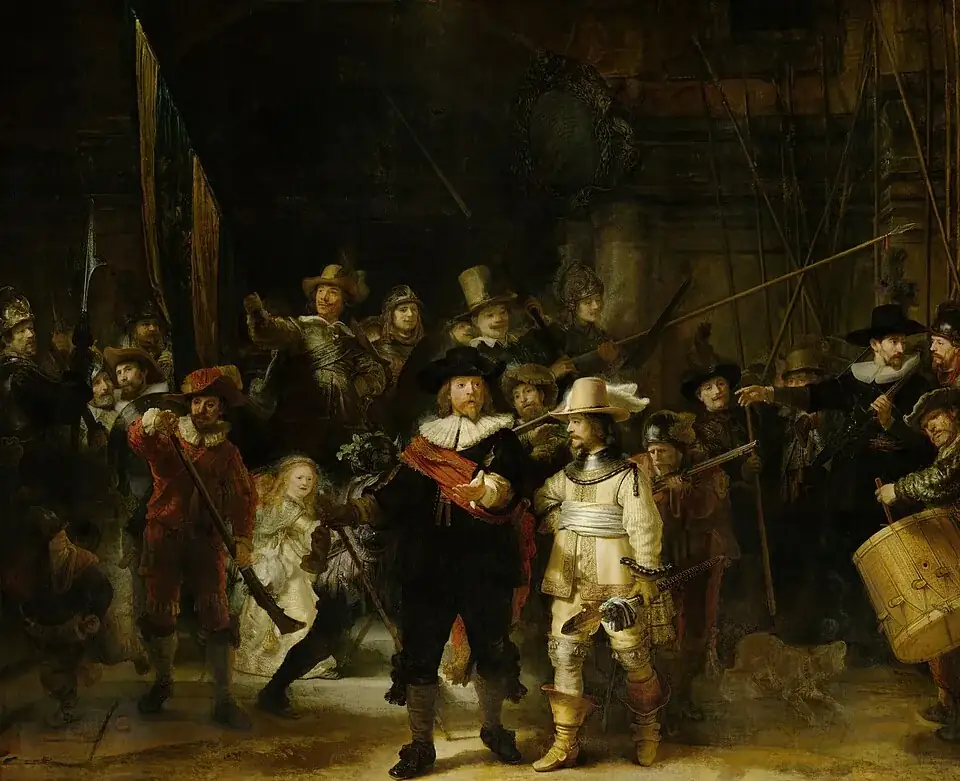
Rembrandt painted the group portrait 'The Night Watch' (original title 'The Militia Company of Captain Frans Banninck Cocq') for the Amsterdam civic guard.1 Breaking with conventional static grouping, he used dramatic motion and chiaroscuro.2 Some patrons were displeased with the placement of figures, but it later became one of his most celebrated masterpieces.3
Evidence ledger
3 claims0 sourced3 unsourced
Every hard fact in the narrative above is registered here. A claim may also record source-only details that the narrative does not repeat; the related-narrative line points to the corresponding passage, not a guarantee that the source supports every word of the body. A claim without a source stays visibly unsourced.
No source registered. This assertion remains unverified.
Rebuilt after English expansion; unverified.
Breaking with conventional static grouping, he used dramatic motion and chiaroscuro.
Related narrativeBreaking with conventional static grouping, he used dramatic motion and chiaroscuro.
No source registered. This assertion remains unverified.
Rebuilt after English expansion; unverified.
Some patrons were displeased with the placement of figures, but it later became one of his most celebrated masterpieces.
Related narrativeSome patrons were displeased with the placement of figures, but it later became one of his most celebrated masterpieces.
No source registered. This assertion remains unverified.
Rebuilt after English expansion; unverified.
Sources and review
English translation predates the current source revision; 3 key claims have no binding source; Unsourced key claims keep the event at structure level
Locations
- Netherlands· 52.37, 4.89· Approximate
evt-1967574e23273ce0Source file:
events/evt-1967574e23273ce0/event.md