
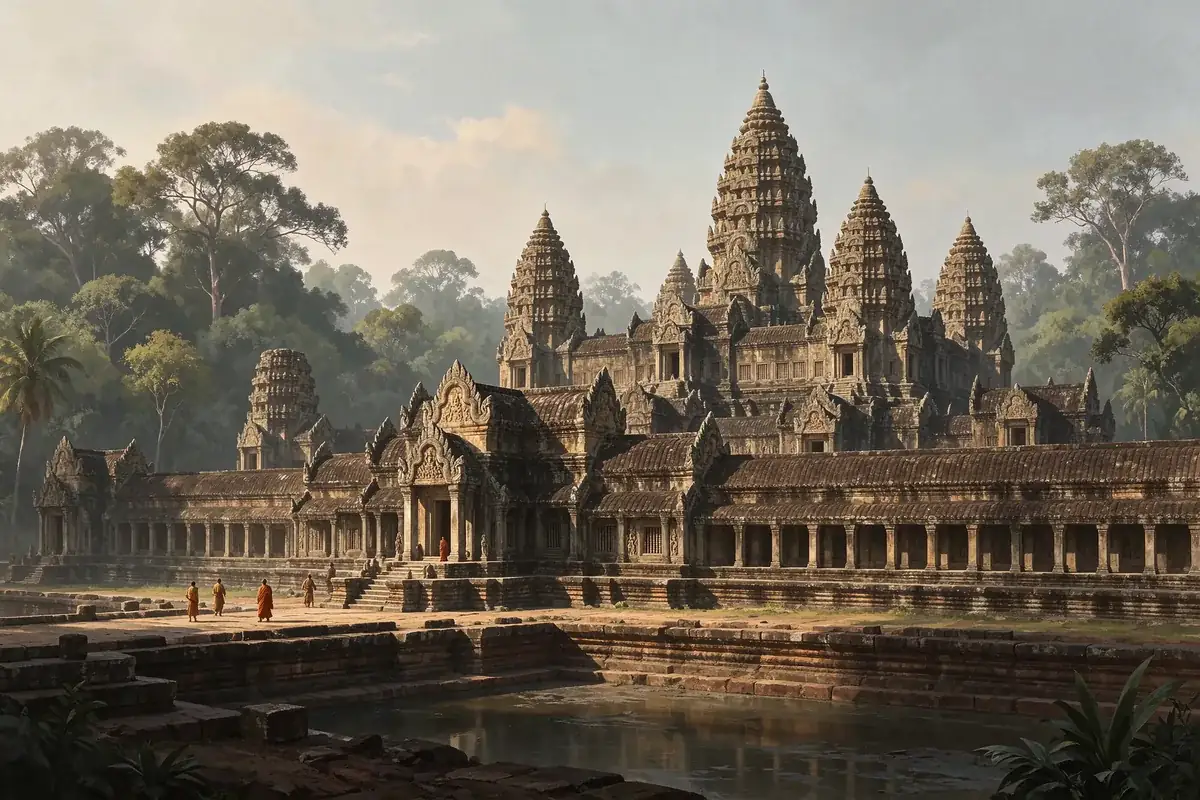
Khmer King Suryavarman II died, but the construction of Angkor Wat, which he had commissioned, was essentially complete.1 Angkor Wat is the largest religious building in the world: 1.5 km from east to west, 1.3 km from north to south, with a central tower 65 m high.2 The entire structure is made of sandstone blocks fitted without mortar.3 The relief carvings at Angkor Wat total 800 meters in length, depicting Hindu myths and the military campaigns of the Khmer Empire.4 Suryavarman II was a devotee of Vishnu, claiming to be an incarnation of the god.5 Angkor Wat served not only as a temple but also as the king's mausoleum.6 It is the highest achievement of Khmer civilization and was listed as a UNESCO World Heritage Site in 1992.7
Evidence ledger
7 claims1 sourced6 unsourced
Every hard fact in the narrative above is registered here. A claim may also record source-only details that the narrative does not repeat; the related-narrative line points to the corresponding passage, not a guarantee that the source supports every word of the body. A claim without a source stays visibly unsourced.
- Angkor WatOpening paragraph and Top Questions
Angkor Wat, temple complex at Angkor, near Siem Reap, Cambodia, that was built in the 12th century by King Suryavarman II (reigned 1113–c. 1150) of the Khmer empire. ... Angkor Wat is the world's largest religious structure, covering some 400 acres ... It was built by Suryavarman II as a vast funerary temple within which his remains were to be deposited. Construction is believed to have spanned some three decades. All of the original religious motifs derived from Hinduism, and the temple was dedicated to the god Vishnu.
Accessed 2026-11-21 · machine excerpt · pending human review
Bulk context rewrite; sources pending
- Angkor WatOpening paragraph and Top Questions
Angkor Wat is the largest religious building in the world: 1.5 km from east to west, 1.3 km from north to south, with a central tower 65 m high.
Related narrativeAngkor Wat is the largest religious building in the world: 1.5 km from east to west, 1.3 km from north to south, with a central tower 65 m high.
No source registered. This assertion remains unverified.
Bulk context rewrite; sources pending
The entire structure is made of sandstone blocks fitted without mortar.
Related narrativeThe entire structure is made of sandstone blocks fitted without mortar.
No source registered. This assertion remains unverified.
Bulk context rewrite; sources pending
The relief carvings at Angkor Wat total 800 meters in length, depicting Hindu myths and the military campaigns of the Khmer Empire.
Related narrativeThe relief carvings at Angkor Wat total 800 meters in length, depicting Hindu myths and the military campaigns of the Khmer Empire.
No source registered. This assertion remains unverified.
Bulk context rewrite; sources pending
Suryavarman II was a devotee of Vishnu, claiming to be an incarnation of the god.
Related narrativeSuryavarman II was a devotee of Vishnu, claiming to be an incarnation of the god.
No source registered. This assertion remains unverified.
Bulk context rewrite; sources pending
Angkor Wat served not only as a temple but also as the king's mausoleum.
Related narrativeAngkor Wat served not only as a temple but also as the king's mausoleum.
No source registered. This assertion remains unverified.
Bulk context rewrite; sources pending
It is the highest achievement of Khmer civilization and was listed as a UNESCO World Heritage Site in 1992.
Related narrativeIt is the highest achievement of Khmer civilization and was listed as a UNESCO World Heritage Site in 1992.
No source registered. This assertion remains unverified.
Bulk context rewrite; sources pending
Sources and review
English translation predates the current source revision; 6 key claims have no binding source; Unsourced key claims keep the event at structure level
- Angkor Wat · Encyclopaedia Britannica (accessed 2026-11-21) Original source ↗
Locations
- Khmer Empire· 13.4, 103.9· Approximate
evt-122af8bafb536394Source file:
events/evt-122af8bafb536394/event.md