
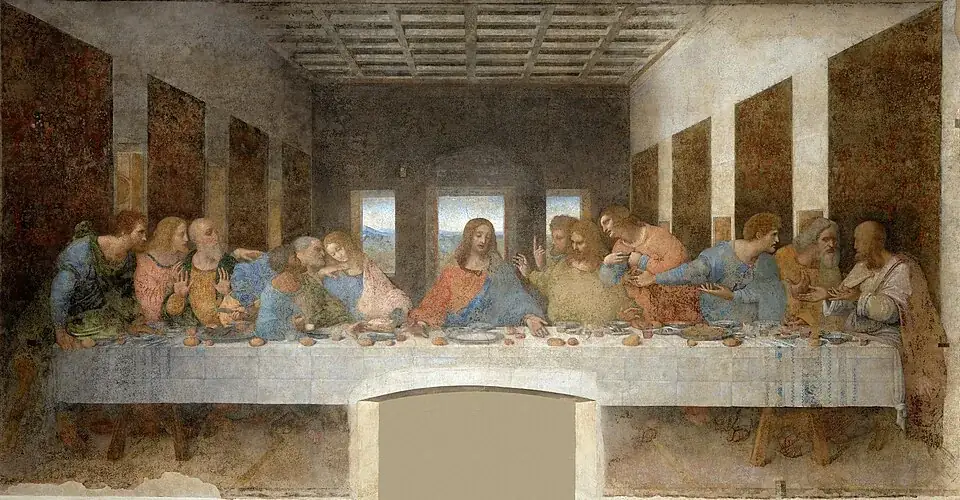
In 1498 Leonardo da Vinci finished The Last Supper on the north wall of the refectory of Santa Maria delle Grazie in Milan, after about three years of work.1 The scene freezes the moment Christ says that one of those present will betray him; the twelve apostles are grouped in four clusters of three, and every perspective line converges on Christ's head.2 Leonardo abandoned true fresco, which must be completed while the plaster is wet, for tempera and oil on a dry wall: the modelling is subtler, but the paint began to flake within decades and the work has been repeatedly restored.3 It is regarded as one of the defining masterpieces of the High Renaissance.4
Evidence ledger
4 claims0 sourced4 unsourced
Every hard fact in the narrative above is registered here. A claim may also record source-only details that the narrative does not repeat; the related-narrative line points to the corresponding passage, not a guarantee that the source supports every word of the body. A claim without a source stays visibly unsourced.
No source registered. This assertion remains unverified.
Bulk context rewrite; sources pending
The scene freezes the moment Christ says that one of those present will betray him; the twelve apostles are grouped in four clusters of three, and every perspective line converges on Christ's head.
Related narrativeThe scene freezes the moment Christ says that one of those present will betray him; the twelve apostles are grouped in four clusters of three, and every perspective line converges on Christ's head.
No source registered. This assertion remains unverified.
Bulk context rewrite; sources pending
Leonardo abandoned true fresco, which must be completed while the plaster is wet, for tempera and oil on a dry wall: the modelling is subtler, but the paint began to flake within decades and the work has been repeatedly restored.
Related narrativeLeonardo abandoned true fresco, which must be completed while the plaster is wet, for tempera and oil on a dry wall: the modelling is subtler, but the paint began to flake within decades and the work has been repeatedly restored.
No source registered. This assertion remains unverified.
Bulk context rewrite; sources pending
It is regarded as one of the defining masterpieces of the High Renaissance.
Related narrativeIt is regarded as one of the defining masterpieces of the High Renaissance.
No source registered. This assertion remains unverified.
Bulk context rewrite; sources pending
Sources and review
English translation predates the current source revision; 4 key claims have no binding source; Unsourced key claims keep the event at structure level
Locations
- Italy· 45.5, 9.2· Approximate
evt-107b6e46387bb225Source file:
events/evt-107b6e46387bb225/event.md